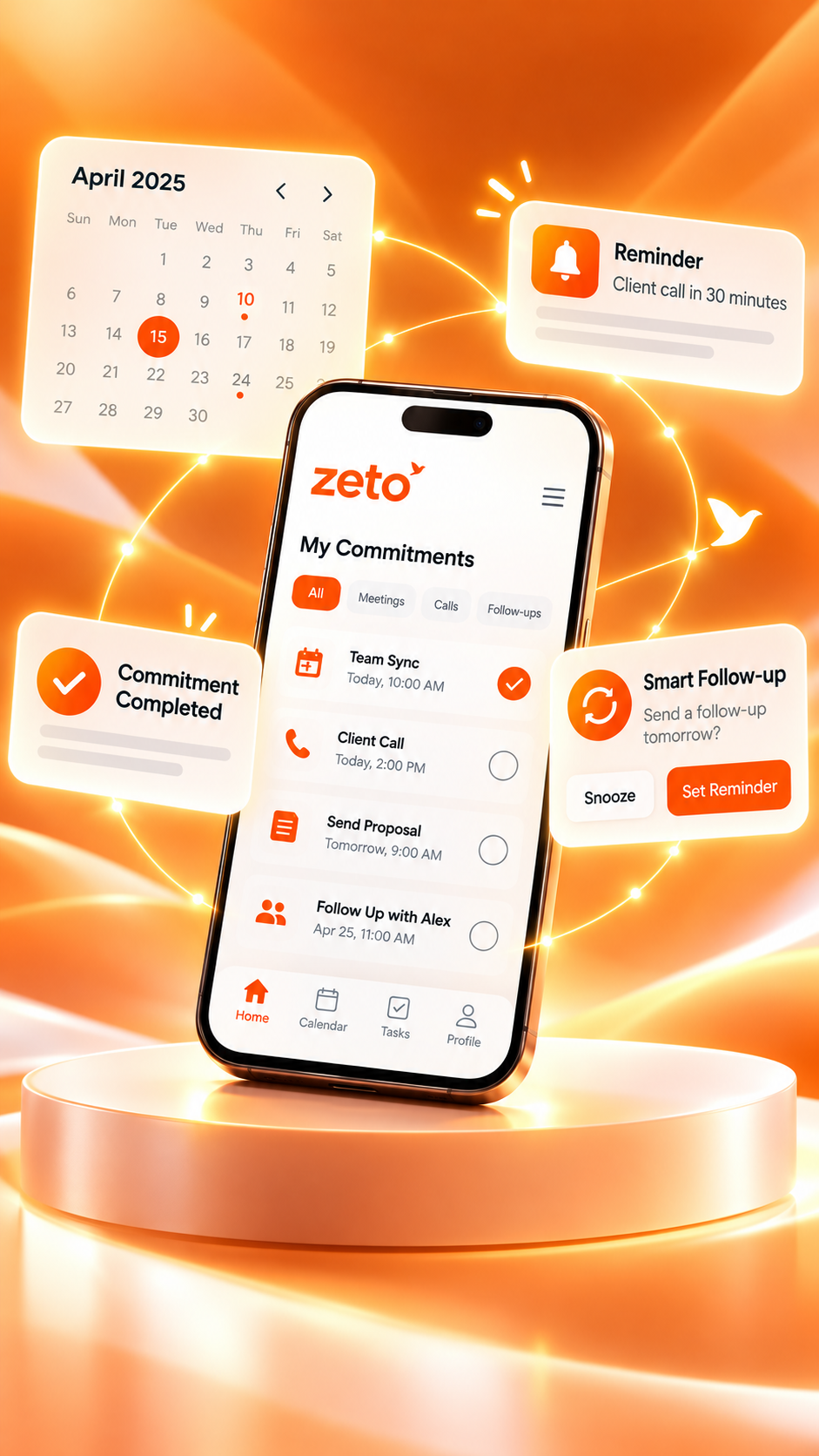
AI-Powered Conversation Search: Finding Answers From Past Calls and Meetings
A customer mentioned a price. A teammate promised an update. A decision was made three meetings ago. What if the answer was as easy to find as asking a question?
“What price did we agree?”
“Who promised the next update?”
“What is still unanswered?”
Answers depend on your saved conversations, recording quality, and the information actually discussed.
From a conversation to a useful answer.
The information you need is often hiding in a conversation you already had.
You know the discussion happened. You can almost remember the answer. But you cannot remember which call, which date, or which person said it.
Consider a typical workweek. A supplier confirms a revised rate over the phone. A customer changes a delivery requirement during a meeting. A colleague agrees to send a document before Friday. Later, when someone asks for a precise number or deadline, the answer is scattered across recordings, notebooks, message threads and memory.
Even organized professionals cannot keep every small detail in mind. Information is often communicated verbally, updated more than once and stored in different places. Searching manually means remembering where something happened before you can even find what happened.
What is AI-powered conversation search?
AI-powered conversation search is a way to retrieve information from previously saved calls, meetings, voice notes or transcripts using natural-language questions. Rather than knowing an exact keyword or file name, a user can ask a question such as “What delivery date did the customer request?” and receive an answer drawn from the available conversation record.
A traditional file search may find the recording called Customer Meeting 24. A transcript search may find a sentence mentioning delivery. Conversation search aims to go further: identify the relevant discussion, interpret the question, and present a concise answer with enough context to check what was actually said.
This is different from asking a general-purpose chatbot a question about the world. In conversation search, the useful evidence comes from your own captured information. The system cannot reliably retrieve a promise or agreement that was never recorded, imported or otherwise made available to it.
A useful answer should distinguish between an actual decision, a suggestion, and an open question. If a deadline was never confirmed, a trustworthy system should not present it as settled fact.
How does AI search through past calls and meetings?
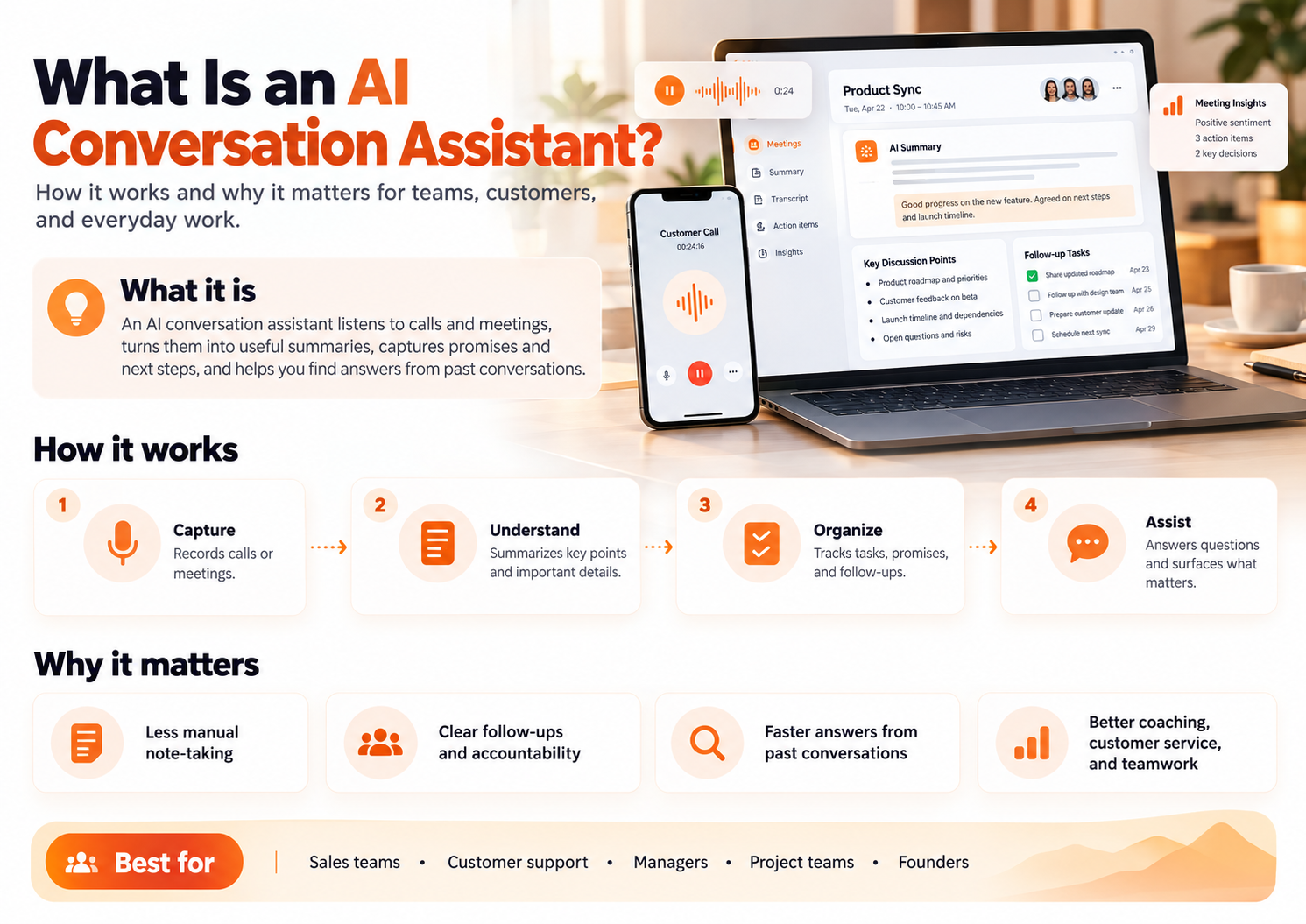
Many AI conversation assistants use several steps to make spoken information easier to retrieve. The exact process varies by product and the source of the conversation.
Capture or import the conversation
A meeting recording, compatible call recording, voice note, or other supported material becomes available to the system. Capture must follow relevant notification, permission and consent requirements.
Convert speech into text
Speech-recognition technology turns audio into a transcript. Background noise, overlapping speakers, accents and technical terms can affect what is transcribed.
Organize context
The system identifies useful topics and details—such as names, quotations, dates, requirements, decisions, pending questions and follow-up commitments. Some tools link them to people, projects or individual conversations.
Understand the question
Instead of matching only an exact phrase, language AI attempts to interpret what the user is asking. “Who is arranging the inspection?” may refer to a statement that used different words.
Retrieve, answer and show evidence
The most relevant available conversation material is used to form an answer. When the product provides source references, users can return to the original context and verify important details before acting.
The benefit comes from connecting retrieval with context. But no system can guarantee a perfect answer. Good workflow design keeps the underlying source easy to inspect.
A question that would otherwise take three calls to answer.
Imagine a sales executive working with Ramesh Traders. During a Monday call, the supplier discusses a price for cement bags, an advance payment, and a tentative delivery date. By Thursday, the project manager wants to confirm the agreed terms before arranging dispatch.
Without an accessible record, the executive may replay several recordings or call the supplier again. With an AI assistant that has access to the relevant conversation, the executive can ask a direct question.
In the recorded discussion, Ramesh quoted ₹415 per bag for 200 bags. A 50% advance was mentioned before dispatch. Delivery was discussed for Thursday, but should be reconfirmed before scheduling.
The important feature is not merely finding a number. It is preserving the conditions around that number: quantity, payment terms, and whether delivery was confirmed or only discussed. The executive can then check the source before sending a purchase confirmation.
Why searchable conversation history matters for professionals.
Conversation search becomes useful when it reduces repeated effort and helps people continue work with the right context. Its value is especially clear in roles built around frequent calls and meetings.
Prepare for client follow-ups
Review the customer's earlier request, objections and pending questions before making the next call—without trying to reconstruct the discussion from memory.
Check promises and deadlines
Look up who committed to send a quotation, share a document or arrange a meeting. Then confirm the extracted date with the original conversation.
Reduce repeat questions
Find a previously discussed rate, specification or customer preference instead of asking the same person to explain it again.
Support team handovers
When permissions allow, a colleague can get the history of a project and understand which decisions are settled or still awaiting confirmation.
Recover context after time has passed
Locate an earlier discussion weeks later, including why a particular requirement changed and what assumptions were mentioned.
Make decisions with better evidence
Compare the current situation with what was actually discussed, while checking the source rather than treating AI output as a final authority.
Conversation search vs. transcripts vs. ordinary notes.
These tools serve different purposes and can be useful together. Conversation search does not make transcripts or human notes unnecessary; it adds a faster way to locate relevant information within them.
Find the file. Read the notes.
- Remember the meeting title or approximate date
- Search for matching words
- Read notes or skim a transcript
- Piece together an answer manually
Ask the question. Check the source.
- Describe what you need in everyday language
- Retrieve likely relevant conversation content
- Get a concise, contextual answer
- Verify important details against the record
A recording preserves the original audio. A transcript makes words readable. A summary highlights key points. Conversation search helps you retrieve the specific answer you need later. The strongest workflow combines these capabilities while preserving the option to review the underlying evidence.
Where can conversation search make the biggest difference?
Sales professionals often need to retrieve pricing discussions, previous objections, customer requirements and promises made during a negotiation. Business owners may need to check what was agreed with multiple customers, vendors and contractors while switching between workstreams.
Project managers can use searchable discussion records to locate decisions about dependencies, schedules and scope changes. Consultants can revisit client requirements before preparing proposals, while service teams can review the history of an issue before responding to a customer again.
Across these examples, the goal is consistent: less guessing, better context and clearer next steps. The usefulness of search still depends on reliable source capture and access controls that reflect who is allowed to view each conversation.
Ask Zeto: answers from your own conversations.
ZETO AI connects the recording or import of supported work conversations with summaries, follow-ups and a searchable conversation history. Its Ask Zeto feature is designed to answer natural-language questions about what was said in calls, meetings and voice notes, while showing the source behind an answer.
For example, the app's published description highlights questions such as “What rate did Ramesh agree?” and “What did I promise this week?” Alongside answers, ZETO organizes details about people, projects and commitments so users can return to the relevant context when work continues.
There is an important practical distinction in how sources reach the app. ZETO does not record phone calls itself; on compatible devices it can process recordings saved by the phone's own Phone app, where supported and permitted. Recording in-person meetings and voice notes follows a separate, supported workflow. Imported audio files and typed notes may also be processed.
For organizational use, ZETO Enterprise presents the wider idea of understanding work conversations, customer commitments and operational follow-through. Access to recorded information should always reflect appropriate permissions, transparency and company policy.
Five ways to get better answers from conversation search.
- Ask a specific question. “What price and quantity did we discuss with Ramesh?” is clearer than “Tell me about that call.”
- Include useful context. Mention the person, project, date or topic when two discussions might look similar.
- Separate decisions from proposals. Ask “Was the date confirmed?” rather than assuming a proposed date became final.
- Check the underlying evidence. Verify financial figures, delivery conditions and customer commitments before sharing them.
- Correct mistakes early. If a name or term was misheard, use available correction or feedback tools and return to the original source.
What should you consider before searching recorded conversations?
Privacy and permission come first. Calls and meetings can contain personal information, confidential commercial discussions and details that should not be shared broadly. Make sure the recording was created lawfully, with the notices and consent required in your location, and that only authorized people can access it.
Speech recognition can mishear names, numbers and technical terms. AI can overlook a correction made later in the call, merge separate comments or state an uncertain conclusion too confidently. Important business decisions should be based on verified evidence, not an unreviewed answer.
Before choosing a tool, review its data-handling disclosures, access settings, retention and deletion controls. ZETO's published privacy policy provides details about its approach to data processing. Availability of recording and import methods may vary by device and platform.
Common questions about AI-powered conversation search.
What is AI-powered conversation search?
It is technology that helps users locate information from previously captured or imported conversations by asking questions in everyday language, often with a concise answer and a reference to the relevant source.
Can AI search through old phone calls and meeting recordings?
It can search information from calls and meetings that have been properly recorded or imported into a supported system. It cannot find discussions that were never made available to the tool, and compatibility varies.
How is conversation search different from a transcript search?
Transcript search usually finds matching words or passages. AI conversation search attempts to understand the meaning of a question and retrieve a relevant answer with context. Both should allow important information to be checked.
Can I ask ZETO AI about a supplier's agreed price?
Yes, Ask Zeto is described as supporting questions about details found in your saved conversations, including previously discussed rates. Verify the answer and its source before using it for a payment, order or contract.
Does ZETO AI automatically record every phone call?
No. ZETO's app description explains that compatible call recordings are saved by the phone's own Phone app and then processed by ZETO where supported and permitted. In-person meeting and voice-note recording are separate app features.
Can conversation search identify unfulfilled promises and follow-ups?
AI tools may extract commitments, dates and unresolved items discussed in the source material. ZETO organizes follow-ups from supported conversations. Check any ambiguous promises or deadlines against what was actually said.
Are the answers always correct?
No. Transcription errors, missing context and unclear statements can affect results. Confirm consequential names, numbers, dates and decisions with the referenced conversation and relevant participants.
Your next answer may already be in your last conversation.
The important things people say during calls and meetings are easy to lose among dozens of other discussions. AI-powered conversation search offers a practical way to reconnect those details to the work that depends on them.
When conversations are captured with appropriate permissions, organized thoughtfully and checked for accuracy, searching them can make follow-ups more focused, handovers smoother and decisions easier to trace. The purpose is not perfect digital memory. It is more dependable access to the information that matters.
Stop searching your memory. Start asking your conversations.
Explore ZETO AI to find useful details from saved work conversations, check what was promised and keep your next steps clearer.