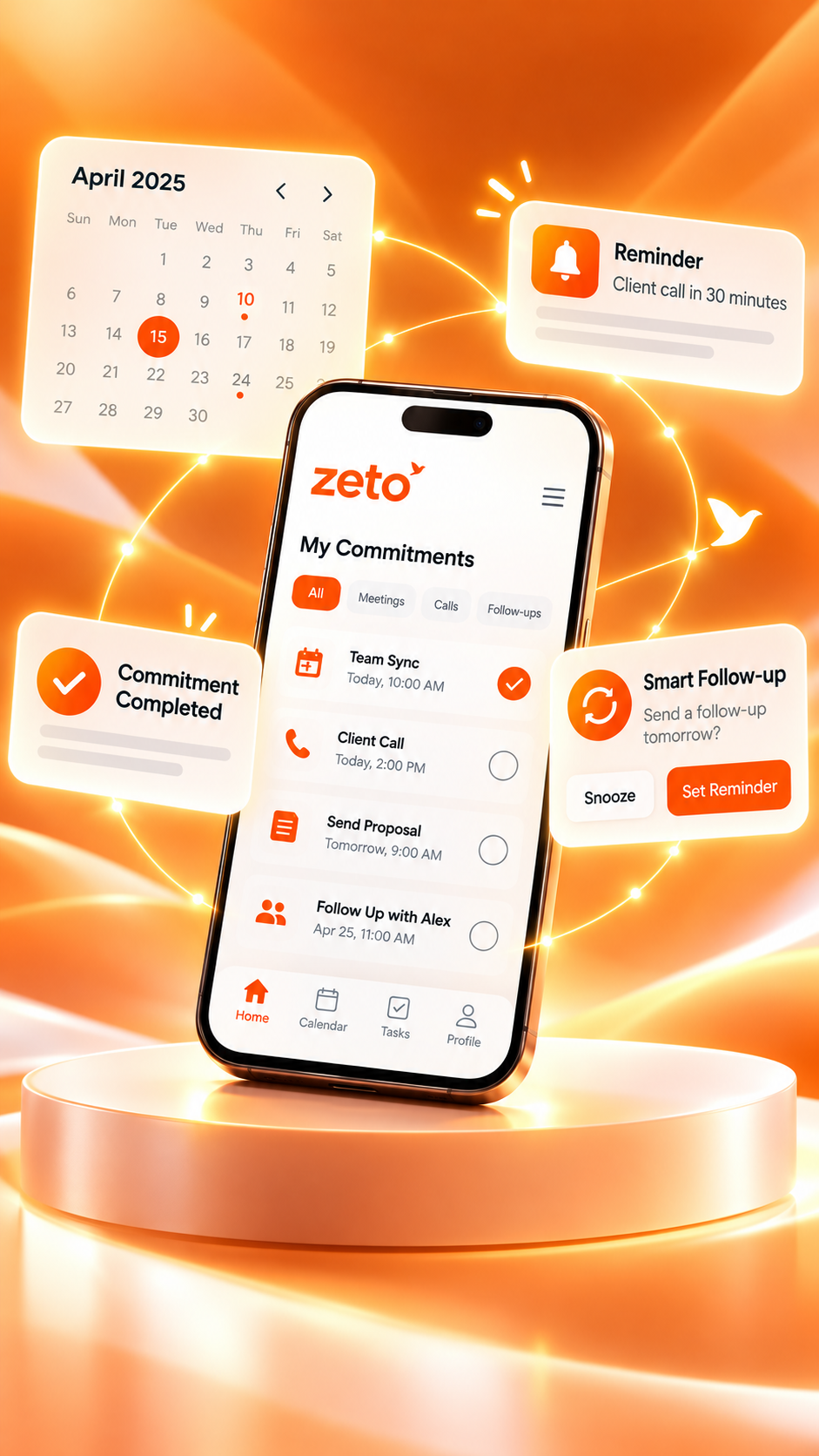
The Future of Work Is Not More Meetings. It Is Better Memory.
A full calendar does not guarantee progress. What matters is whether people can recover what was decided, remember who committed to what, and move forward without starting every conversation from zero.
The team agreed to send the revised proposal by Tuesday. Priya would confirm the updated specifications, and the delivery date remained open.
Think about the last meeting you attended. Not just the topic or the people in the room—but the exact decision, who took responsibility, which concerns were unresolved, and what needed to happen next. Would everyone who attended give the same answer?
In busy organizations, one meeting leads to another. Customer calls, project reviews, supplier discussions and internal updates arrive faster than people can consolidate what they mean. Teams may leave a conversation feeling aligned, only to discover days later that they remember the agreement differently.
The response is often to schedule another meeting. But the bigger opportunity may be simpler: build better conversation memory, so people can revisit decisions and move work forward without repeatedly reconstructing the past.
Why more meetings do not automatically create more progress
Meetings can be valuable. Teams use them to negotiate trade-offs, resolve uncertainty, exchange expertise and agree on priorities. The problem starts when a meeting becomes a temporary island of shared understanding. Everyone heard the discussion, but nobody can easily retrieve its outcome later.
A packed calendar may produce plenty of activity while still leaving important questions unanswered. Was the client asking for a revised quotation or merely considering an option? Did the manager approve the change or request more information? Who was supposed to call the supplier? Without a reliable record, the next conversation often begins by reopening the previous one.
Teams spend time revisiting background that was already discussed.
An agreement exists, but the next step or responsible person is uncertain.
Work stalls while people search for what was said or approved.
Reducing unnecessary meetings helps, but it is only part of the solution. A ten-minute discussion that preserves a clear decision can be more useful than an hour-long meeting that leaves everyone with a different interpretation.
The human memory problem behind workplace follow-ups
People are not designed to hold every future commitment at the front of their attention all day. Cognitive scientists use the term prospective memory for remembering to do something later, such as sending a proposal tomorrow or calling a customer at a specific time. Research has found that demanding ongoing tasks can make it harder to remember delayed intentions at the right moment.
Interruptions add another layer. A manager might agree to review a contract, answer an urgent supplier call, join a different meeting and then return to an overflowing inbox. The original intention is still important, but there may be no clear cue to bring it back at the appropriate time.
External tools—notes, calendars, reminders and searchable records—can help people keep track of commitments. This idea is often described as cognitive offloading: relying on an external system for part of the remembering task. The system does not replace thinking. It makes crucial information easier to recover when thinking is needed.
“The best meeting memory is not a longer transcript. It is a clearer path from what was said to what happens next.”
ZETO AI · Editorial perspectiveWhat a useful meeting memory should actually contain
A transcript can capture what people said, but a working memory for teams needs structure. When you return to a conversation after a week, you are rarely looking for every sentence. You are trying to answer a small number of high-value questions.
- Decision: What did the group actually agree to do?
- Reason: What concern, customer need or constraint shaped that choice?
- Owner: Who accepted responsibility for the next step?
- Deadline: When does the commitment need attention?
- Open question: What still needs confirmation before work can proceed?
- Source: Which conversation supports the remembered detail?
Those six elements turn a record of speech into practical working context. They also reduce ambiguity: people can return to the source instead of debating what someone thinks they remember.
A practical example: the proposal that kept returning to meetings
Consider a fictional project team preparing a proposal for a commercial customer. During a Thursday review, the customer requests a change to the material specification, asks for a revised quotation by Tuesday, and says the installation date must be confirmed after a site inspection.
Same meeting. Two very different outcomes.
The discussion goes well, but three employees leave with different priorities. One remembers the quotation. Another remembers the installation date. The person handling the specifications thinks the change is optional.
On Monday, the sales manager asks what was agreed. The team searches messages, calls one another and schedules a clarification meeting. The customer receives a delayed update.
The requirement, Tuesday deadline, responsible person and outstanding installation decision are visible. The team verifies details, completes the quotation and returns to the customer with a relevant update.
The difference is not that AI completed the proposal. People still need to review specifications, approve pricing and send the response. The difference is that they can recover the context without reconstructing it from memory.
This is where meeting summaries and conversation search can be useful: they help preserve the link between what was discussed and what someone needs to do.
Meeting notes, transcripts and AI conversation memory: what’s different?
| Approach | What it does well | What may still be difficult |
|---|---|---|
| Manual meeting notes | Capture selected highlights and personal interpretation | Notes can omit a key condition or remain in one person’s notebook |
| Meeting transcript | Preserve detailed spoken content for later review | Finding one promise within a long discussion may take time |
| Meeting summary | Condense topics, decisions and action items | Important nuance can be missing unless the source is checked |
| Searchable conversation memory | Help retrieve relevant answers across captured conversations | Quality depends on recording coverage, transcription accuracy and permissions |
These approaches are not competitors in every situation. A good workflow may use all of them: a permitted recording, an accurate transcript, a concise summary, visible follow-ups and a way to check the underlying conversation.
A better meeting workflow: before, during, after and next time
Better organizational memory does not require turning every conversation into a complicated process. A few consistent habits can make a large difference.
Review the previous conversation’s summary, unresolved questions and commitments. Begin with context instead of repeating the same background.
Confirm what was decided, who will act and when. Where recording is lawful and permitted, capture the discussion using a supported method.
Review names, numbers, dates and commitments. Correct errors and enter any follow-up into the system your team uses to manage work.
Before contacting the customer or planning another meeting, retrieve what was discussed previously and identify what has changed.
How ZETO AI supports conversation memory
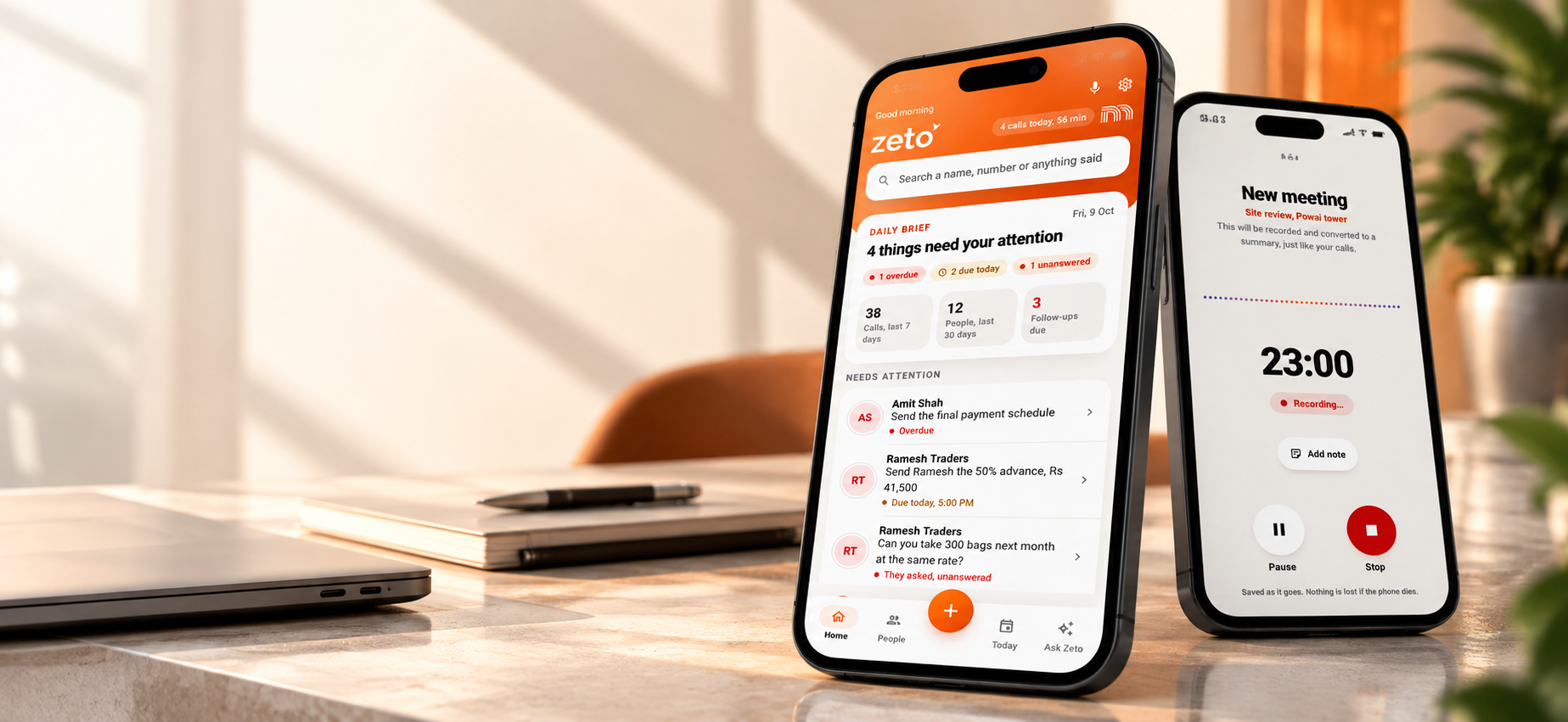
ZETO AI is designed to help professionals turn supported, captured work conversations into summaries, reminders and a searchable history. Instead of treating each call or meeting as a separate event, it helps organize what happened, what was promised, what was decided and what remains open.
Based on its published app descriptions, ZETO AI offers meeting and voice-note capture, summaries, follow-up reminders, people-based conversation history and Ask Zeto AI—a way to ask questions about your own available conversations and see where an answer came from.
Three useful questions a professional might ask
- “What did the supplier agree about the delivery timeline?”
- “Which customer follow-ups are due today?”
- “What did we leave unresolved in the last project discussion?”
The purpose is to find the relevant context faster, not to assume the generated answer is always perfect. Important details should still be checked against the available source conversation, especially before a payment, quotation or contractual decision.
Recording compatibility matters: on supported Android phones, ZETO AI can process call recordings saved by the device’s own Phone app; ZETO AI does not itself record Android phone calls. Its iPhone app supports meetings, voice notes, notes and supported recording/import workflows. Availability and steps can differ by device and platform, and recording requires appropriate consent.
For leaders, memory should include business context—not just meeting minutes
For a business leader, the challenge goes beyond recalling one discussion. Important context is spread across customer interactions, project handoffs, team conversations and follow-ups. A traditional report can show that an activity happened; the underlying conversation may explain why a customer remains concerned or why a task is blocked.
ZETO Enterprise presents workspaces for activity, follow-ups, customer signals and people-related context. The intention is to help leaders revisit relevant, permitted work conversations and ask better coaching or operational questions before drawing conclusions.
This is not a reason to turn conversation records into surveillance or automatic judgments about employees. Coverage may be incomplete, context matters, and managers should discuss findings with the people involved before taking action.
Seven habits for a workplace that remembers better
- Finish with a decision recap. Summarize the outcome aloud before the meeting ends.
- Put an owner beside each task. “Someone will follow up” is not a useful assignment.
- Record a realistic due date. A clear time makes reminders more actionable.
- Keep decisions separate from discussion. Ideas considered are not the same as commitments approved.
- Make outstanding questions visible. An open issue should not quietly turn into an assumed decision.
- Use one retrievable source of context. Avoid scattering the only useful details across disconnected notes and chats.
- Review the source before high-stakes action. Recheck dates, prices, promises and approvals rather than trusting a brief summary alone.
Even teams without specialized software can begin using these practices. AI can make reviewing and retrieving information easier, but good meeting habits remain essential.
Better memory also requires privacy, accuracy and control
Capturing conversations should never be treated as permission to record everyone without their knowledge. Use recording and import methods that comply with applicable law, company policy and participant consent. Inform people about relevant team visibility and access controls.
AI summaries and answers may misunderstand accents, dates, amounts or context. Review important facts, correct mistakes where possible and use human judgment for consequential decisions. When a conversation was not captured, a system cannot reliably retrieve details that it never received.
The future is not meeting-free. It is context-rich.
Work will always require live discussion. Creative ideas, sensitive decisions and difficult negotiations benefit from human conversation. The opportunity is not to eliminate meetings—it is to make each useful discussion carry forward into the next action.
Imagine a professional beginning the morning with a reliable view of outstanding commitments, entering a customer call with the previous agreement in mind, and closing the day knowing which decisions still need attention. That is a more meaningful vision of workplace productivity than simply adding another meeting to the calendar.
Better memory gives conversations continuity. Continuity makes follow-through easier. And follow-through is what turns talk into progress.
Frequently asked questions
What does “better memory” mean in the workplace?
It means keeping important decisions, responsibilities, deadlines and context in a reliable form that authorized people can find when they need it. It is more than storing every word of a meeting.
Can AI meeting summaries replace meetings?
No. AI summaries can help people revisit what was discussed, but they cannot replace discussion, negotiation or human decisions. They may reduce some repetitive clarification when prior context is easy to recover.
How does AI conversation memory differ from a transcript?
A transcript stores spoken words. An AI conversation memory workflow can organize summaries, commitments, reminders and searchable answers from supported captured content. Accuracy and retrieval depend on what was recorded and processed.
Can ZETO AI search past meetings and conversations?
Yes. Ask Zeto AI is described as answering questions about the user’s available conversation history and showing sources. It is not a substitute for checking important information against the original recording or transcript.
Does ZETO AI automatically record every phone call?
No. On supported Android phones, it processes recordings saved by the phone’s own recording feature. Other recording and import options depend on the platform and device. It should not be described as automatically recording every call on every phone.
Can better conversation memory help with customer follow-ups?
It can make customer requirements, promises and due dates easier to review. A salesperson still needs to verify the information, contact the customer and complete the agreed action.
How can business leaders use conversation intelligence responsibly?
They can review permitted conversation context alongside business outcomes, clarify responsibilities and discuss improvement opportunities with employees. They should respect consent, access permissions, incomplete coverage and the possibility of AI errors.
What is the easiest way to improve meeting follow-through today?
End each important meeting with a short, confirmed record: decision, responsible person, due date and unresolved question. Put follow-ups into a system the team actually checks.
Make every important conversation easier to remember.
Discover how ZETO AI helps turn supported calls, meetings and voice notes into organized summaries, follow-ups and searchable context.