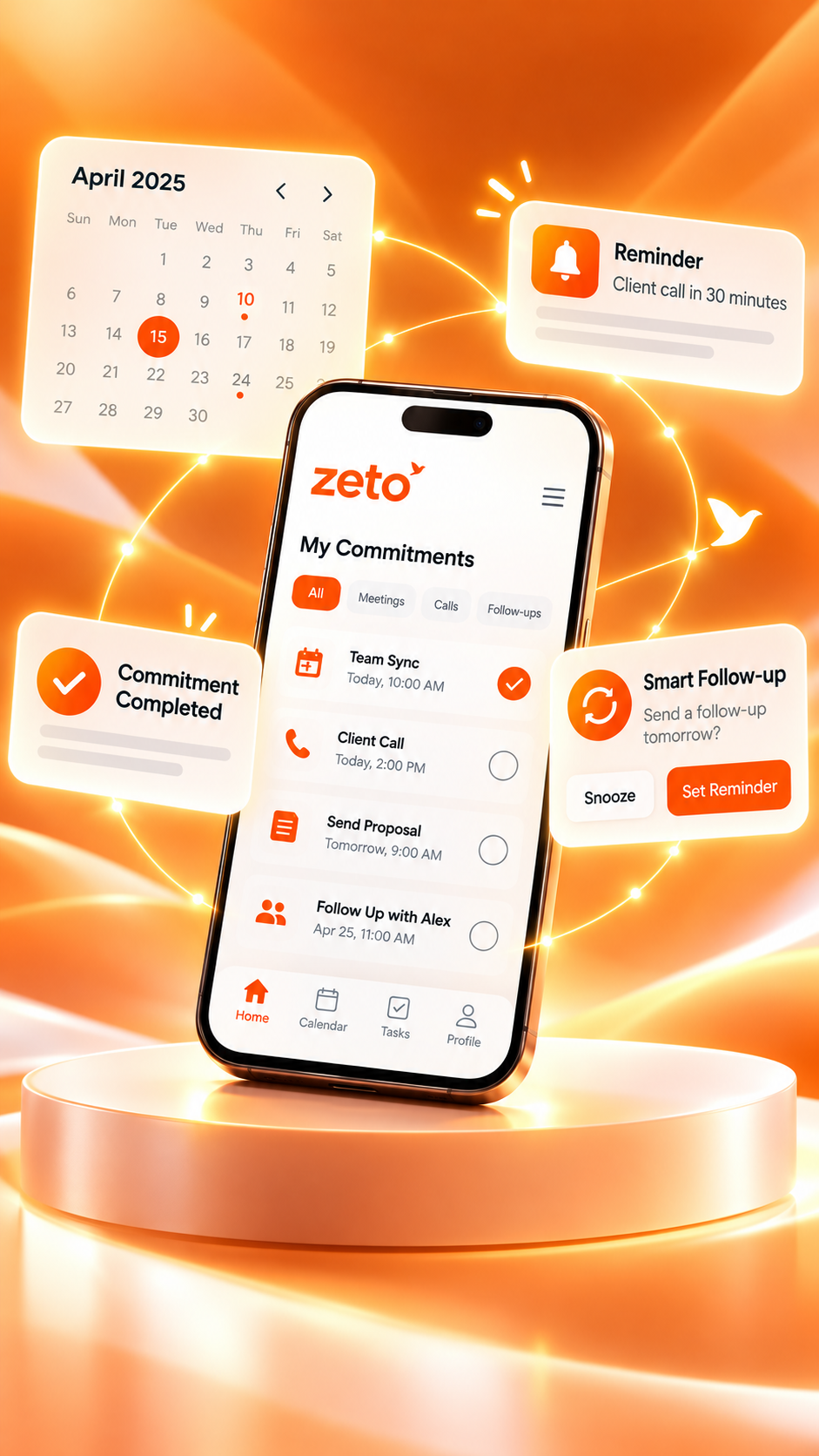
AI Conversation Assistant for Entrepreneurs: Why ZETO AI Matters
Founders often make their most important decisions in conversations. Learn how to preserve the context behind customer feedback, supplier commitments and new ideas.
“The pilot customer wants a simpler package. Check the cost before we commit to a launch date.”
Founders often make their most important decisions in conversations. Learn how to preserve the context behind customer feedback, supplier commitments and new ideas.
The goal is to help readers decide what information needs to be captured, how it should be reviewed and where ZETO AI fits into that workflow. A useful assistant supports human judgment rather than replacing it.
Founders work through conversations, not only dashboards
An early-stage entrepreneur spends much of the day speaking with customers, mentors, suppliers and a small team. One conversation changes the price of a product. Another reveals a repeated complaint. A third creates a promise to deliver a revised plan. The information is valuable, but it may be scattered across notes, messages and memories.
An AI conversation assistant can help preserve the context of discussions and make them easier to review. It does not replace judgment about product strategy, fundraising or operations; it provides a more usable record of what people actually said.
Reasons people buy, hesitate or decline.
Availability, conditions and costs.
Who owns a decision or task.
The person waiting for an answer.
Customer discovery works only when you remember the details
A founder may finish a series of interviews with a broad impression that customers want a cheaper option. But individual responses may be more nuanced: one customer objects to onboarding complexity, another wants flexible billing, and another is satisfied with the price but worried about delivery.
If those distinctions are lost, product decisions can be based on a misleading generalization. A careful conversation record helps separate an exact customer statement from the founder’s interpretation.
| Conversation detail | Risk if forgotten | Useful follow-up |
|---|---|---|
| Customer objection | Build the wrong feature | Check what the customer actually disliked |
| Product promise | Set an unrealistic expectation | Confirm the commitment and timing |
| Supplier condition | Make a costly assumption | Verify cost or availability |
| Team idea | Confuse suggestion and decision | Record who will test it |
Example: a pilot customer changes the plan
Imagine a small software founder conducting three pilot conversations. One customer asks for simpler onboarding; another requests a specific export format; a third says the team can try the product only after its internal security review. All three are useful signals, but none by itself proves what the entire market needs.
A conversation assistant can help the founder revisit each interview and keep separate the customer’s request, the agreed experiment and the next meeting. It should not invent market validation or automatically decide which feature deserves funding.
Draft a shorter setup flow and request feedback.
Check which format is required and why.
Confirm the decision process and next contact date.
Why ZETO AI can be relevant to entrepreneurs
ZETO AI’s store descriptions cover capturing meetings and voice notes, processing supported call recordings on Android, creating structured summaries, organizing commitments and retrieving information through Ask Zeto. Its people history can help a founder revisit what a particular customer or supplier said earlier.
This is useful when a founder cannot devote a dedicated note-taker to every discussion. A lightweight workflow allows one person to keep conversations organized and check open promises before the next call.
ZETO AI should not be marketed as a complete founder operating system, a replacement for customer research or a promise of higher revenue. It is a conversation-oriented productivity assistant that supports clearer follow-through.
See the idea in action

The important step is to connect the recorded discussion with the right person, decision and follow-up, while checking any critical details against the original source.
A practical entrepreneur conversation workflow
- Define the purpose. Know what you want to learn before a customer interview.
- Capture only with appropriate consent. Use permitted recording or written notes.
- Review immediately. Check the generated summary against what the customer intended.
- Separate fact from hypothesis. Distinguish the customer’s words from your interpretation.
- Schedule the next step. Confirm who will send the prototype, quote or clarification.
This workflow creates better source material for product decisions, but it does not eliminate the need to validate patterns with additional customers.
When the company grows beyond one founder
As a team expands, valuable information can stay trapped in individual inboxes and memories. An owner may not know which customer condition a colleague agreed to or why a supplier delayed a promised delivery. A transparent, permission-aware conversation history can improve handoffs.
ZETO Enterprise is described as bringing permitted work conversations and open commitments into shared management context. That makes it relevant to teams that need more visibility, provided participants understand access and managers use information fairly.
- Ask for context, not just status: why is the customer waiting?
- Check completion: a generated task is not proof that work happened.
- Preserve ownership: confirm the person responsible for each promise.
- Respect privacy: use team conversation information only for legitimate purposes.
The human role in an AI-supported startup
Entrepreneurs should still review original conversations for quoted figures, customer consent, sensitive terms and important commitments. AI can summarize confidently while missing a qualification such as “only after the trial” or “subject to board approval.”
Recording may require notice and consent, and the app has access controls and privacy choices that should be reviewed before sensitive discussions are uploaded. Building a company on trust requires disciplined information handling as well as speed.
Frequently asked questions
What is an AI conversation assistant for entrepreneurs?
A tool that helps founders capture, summarize, organize and revisit business discussions and their follow-ups.
Can ZETO AI help with customer discovery?
It can help organize interviews you lawfully capture, but research findings still require human interpretation and validation.
Will the app automatically prioritize startup features?
No. Its published capabilities are conversation summaries, reminders and source-backed retrieval, not product strategy automation.
Can a founder ask about a supplier’s previous quote?
Ask Zeto is designed to answer from captured conversations with source references, if that quote is available.
Does ZETO AI replace project management software?
It can complement a task system with conversation context, but does not establish a complete replacement.
Can I use voice notes while travelling?
The official listings describe voice-note recording and structured summaries on mobile.
How should teams handle sensitive conversations?
Explain recording and access, obtain required consent and use company-approved retention and deletion controls.
Is ZETO Enterprise suitable for growing teams?
Its website describes contextual team visibility for permitted conversations and follow-ups. Verify access configuration for your use case.
ZETO AI Android listing · ZETO AI iPhone listing · ZETO AI official website · ZETO Enterprise overview
Turn conversations into progress.
Explore ZETO AI for conversation summaries and ZETO Enterprise for a clearer picture of permitted work conversations, commitments and follow-through.
AI-generated summaries and answers should be checked against source conversations, particularly for dates, prices, names and promises. Recording requires appropriate permissions and consent. Product availability may vary by platform.