How to Identify Unanswered Customer Questions Using AI Conversation Intelligence
Customer questions can disappear inside busy call histories. Learn how to find the open loops, confirm who owns the answer and respond with the right context.
AI conversation intelligence can help identify unanswered customer questions by reviewing permitted call and meeting records for requests, promises, missing information and pending responses. A team should then verify the original context, assign an owner and confirm that the customer actually received a useful answer.
Why customer questions get lost
A customer rarely asks just one question. During a quotation call, they may ask about delivery, payment terms, product availability and whether an older offer still applies. The sales representative may answer two questions immediately and promise to confirm the rest. The CRM records “call completed,” but the unresolved questions are not necessarily visible in that activity count.
Problems become more likely when a question crosses teams. Sales promises to ask production; production expects purchasing to confirm stock; nobody knows who must call the customer. The delay may look like low employee responsiveness even when the real problem is an unclear handoff.
Conversation intelligence is useful when it preserves the question, context and next action together. It is not enough for a system to say “customer concerned about delivery.” A manager needs to know what the customer specifically asked, what the representative actually promised and whether that promise has been fulfilled.
Five types of questions worth tracking
| Question type | What the customer might ask | What to verify |
|---|---|---|
| Pricing | “Does this rate include transport?” | Price basis, taxes, duration and who confirmed it |
| Delivery | “Can you send it before Friday?” | Stock position, actual committed date and dependencies |
| Technical | “Will this product suit our existing floor?” | Site conditions, technical review and documented qualification |
| Commercial | “Is a 30% advance acceptable?” | Approved payment condition, not just a conversational suggestion |
| After-sales | “Who will handle the complaint?” | Named owner, response deadline and resolution outcome |
These categories help managers distinguish a simple request for information from a commercial commitment that requires approval. They also help teams avoid treating every unanswered question as the salesperson’s mistake.
A practical five-step review process
- Capture with permission. Use work conversations that have been recorded or imported through approved methods, with appropriate notice and access controls.
- Find open questions. Review summaries and searchable history for phrases such as “please confirm,” “will you check,” “what about,” and “send details.” Treat AI flags as candidates, not confirmed failures.
- Check the actual source. Open the relevant transcript or recording and compare the customer’s question with what was said later in the conversation.
- Assign clear ownership. Make one team or person responsible for obtaining the answer, with a due date based on the customer’s need.
- Close the loop visibly. Verify the customer received the answer; a task marked complete internally is not always the same as a resolved customer question.
Example: a factory-floor restoration enquiry
Consider a fictional customer in Bengaluru reviewing a floor-restoration quotation. During a call, the customer asks whether the work can happen over a weekend, how soon the area can return to use, and whether the quote includes surface preparation. The representative confirms the quotation amount but says the technical team will check the other points.
Later, a dashboard could show that the quotation was sent and the opportunity is active. But a conversation review reveals three specific questions with no confirmed customer-facing response. The manager’s next move is not to accuse the representative of neglect. It is to check whether the technical team was contacted, whether any answer was approved and who is responsible for updating the customer.
The lesson is that unanswered questions are workflow signals. They help identify the next action and the source of delay. This is a fictional example, not a ZETO customer result or a claim that the software autonomously resolves these tasks.
Where ZETO AI and ZETO Enterprise fit
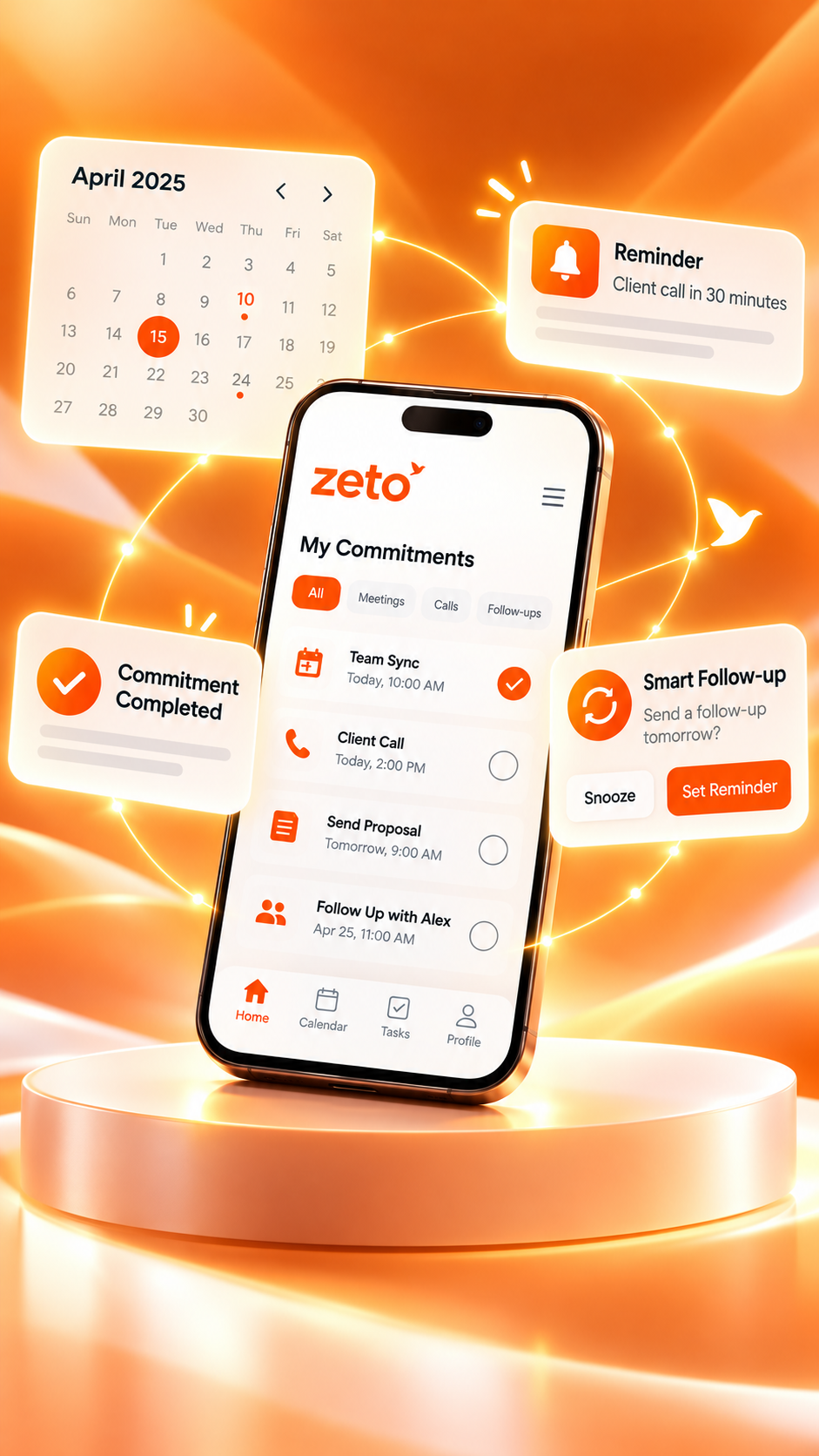
ZETO AI organizes captured conversations into summaries, commitments and searchable history. On the Enterprise side, the published experience emphasizes customer signals, customers, open commitments and conversation context. These views can help a manager investigate where a question originated and what follow-through is still needed.
A useful workflow is to start with the relevant customer or conversation, inspect the summary and source, identify the missing response, then update the responsible employee or customer-facing process. Human review remains essential because automated summaries may miss an answer, misunderstand a number or overlook a later conversation.
ZETO is a complement to the organization’s CRM, service desk and operational records—not proof that a question has been resolved or that a particular employee should be penalized.

Metrics that reflect real resolution
| Measure | Meaning | Review caution |
|---|---|---|
| Unanswered-question backlog | Open questions awaiting an external response | Exclude questions already answered in another channel |
| Time to verified answer | Time from request to confirmed answer | Separate customer-dependent delays |
| Ownership clarity | Share of open questions with a named owner | An assigned owner may still need another team |
| Repeat-question rate | Customers asking the same thing again | May reflect a changing requirement, not poor service |
Start with a small, manually reviewed sample before automating measurement. Track error rates in the classification itself; otherwise a polished dashboard can conceal incomplete or misleading data.
Privacy, consent and fair interpretation
Customer conversations can include prices, personal information and confidential plans. Use recordings only where permitted, provide appropriate notices, limit access to people who need the information and follow your organization’s retention rules.
Do not infer customer sentiment or employee intent from a short transcript fragment. Give employees the chance to explain missing context, and confirm outcomes with the customer or systems of record before making consequential decisions.
Understand the conversation behind the outcome.
Explore how ZETO Enterprise brings permitted customer discussions, open commitments and follow-up context into a clearer picture.
Frequently asked questions
What is an unanswered customer question?
A question or request that has no verified answer communicated back to the customer. It may be pending technical input, approval or a simple callback.
Can AI identify unanswered questions automatically?
AI can suggest likely open questions from captured conversations, but people should confirm whether an answer appears in another conversation or system.
How is conversation intelligence different from a CRM?
A CRM can track opportunities, activities and notes; conversation intelligence adds detail from available recorded discussions. Modern CRMs may also include similar capabilities.
Can ZETO AI send answers to customers automatically?
Do not assume automatic customer messaging. The described ZETO experience focuses on summaries, searchable context and follow-ups; teams should manage their customer replies through approved channels.
Should managers monitor every employee conversation?
Review should be proportionate, permission-based and tied to a legitimate business purpose, with staff awareness and appropriate access controls.
How can a business reduce unanswered questions?
Record the exact question, assign an owner, set a response time and verify the answer was received, not merely prepared.
Can a customer question be resolved without a phone call?
Yes. A response may be sent in email, chat or another channel. A complete review must consider those records as well.
Is ZETO Enterprise a replacement for a customer support platform?
Not necessarily. It is positioned around conversation and follow-up context, and should be evaluated alongside existing CRM and support workflows.
Sources and further reading
Product descriptions were checked against ZETO’s published pages. Examples and recommended processes are educational, not claims about live customer accounts or guaranteed results.
ZETO Enterprise overviewZETO AI AppZETO Android app descriptionGoogle’s people-first content guidance