AI Conversation Intelligence for Small Businesses in India: A Practical Guide
A small business may have one owner, a few salespeople and dozens of important conversations every day. Here is how to turn that context into clearer action.
AI conversation intelligence helps a small business organize information from permitted calls, meetings and voice notes so people can revisit customer requirements, supplier commitments and open follow-ups. It works best alongside existing records and human review, not as a replacement for the owner’s judgment.
Why conversation gaps hurt small businesses
In many Indian small businesses, the owner manages sales, purchasing, operations and service at the same time. A customer calls while the owner is visiting a site. A supplier changes a delivery date. An employee agrees to send a revised estimate. By evening, each person remembers a slightly different version of events.
This is not necessarily a lack of effort. It is an information problem: critical context lives in individual calls, informal messages and personal memory. When the business grows, the cost of finding that context grows too.
A practical conversation-intelligence workflow starts small. The question is not “How do we monitor every conversation?” It is “How do we make important, permissioned conversations easier to review and act on?”
Four practical use cases in India
1. Traders and distributors
A buyer confirms a quantity and a rate, but the order depends on freight and an advance payment. A summary can help the salesperson retrieve the discussion; the final rate must still be checked against the approved quotation and invoice.
2. Service businesses
A customer describes an issue, asks for a technician and requests a callback. Capturing the promise and owner helps prevent the second call from starting with “Please explain everything again.”
3. Contractors and project teams
A project meeting discusses site readiness, access times and a delivery dependency. A structured note makes the pending items easier to distinguish from final approvals.
4. Agencies and consultancies
Several stakeholders make changes during a review. A searchable discussion history can help the team prepare a more accurate summary of what was requested, agreed and left unresolved.
What to capture from every important conversation
| Information | Business value | What to verify |
|---|---|---|
| Who and which project | Avoids mixing customers and sites | Names, company and project identity |
| Customer requirement | Clarifies the actual need | Quantity, service scope, constraints |
| Decision or approval | Prevents treating an idea as a final decision | Who has authority to approve |
| Commitment | Makes follow-through visible | Owner, due date and conditions |
| Open question | Shows what still needs an answer | Source and customer-facing resolution |
Use a repeatable format, but keep original context available. A useful summary is not simply shorter text; it should help the next person make the right decision.
A realistic 30-day adoption plan
- Week 1 — select one workflow. Choose quotations, supplier delivery updates or service callbacks. Do not attempt to redesign every department.
- Week 2 — establish recording and access rules. Explain permissions, employee awareness, who can see conversations and what information must not be collected.
- Week 3 — test summaries with real users. Compare a small number of AI summaries to original sources, checking especially names, rates, dates and approvals.
- Week 4 — introduce a follow-up routine. Assign owners to genuinely open actions and evaluate whether repeat calls and missed updates reduce.
Success might be as simple as fewer lost quotation details or quicker retrieval of a supplier promise. Avoid claiming an ROI percentage until the business has measured its baseline and outcomes.
Example: a distributor handling a supply delay
Imagine a Bengaluru distributor whose customer orders materials for a site opening. The supplier says that 60% of the order can ship on Wednesday, with the remainder pending stock confirmation. The customer, however, needs the entire order before Friday.
Without a shared record, the sales team may remember only “Wednesday dispatch,” and the customer receives an incomplete assurance. A conversation record can distinguish partial dispatch, remaining stock and the unresolved delivery promise. The owner can then decide whether to source the balance elsewhere or renegotiate expectations.
The value lies in better decisions, not in automatic predictions. An AI summary should be checked against the supplier’s formal confirmation, especially when dates or amounts affect the customer’s operations.
How to evaluate a tool before paying for it
- Capture compatibility: Check which call recordings, meeting formats and audio imports are supported by the devices your team actually uses.
- Languages: Test real business conversations in the languages and accents your staff and customers use; do not assume perfect accuracy from a language label.
- Source-backed search: Make sure staff can verify an answer against the relevant discussion.
- Follow-up workflow: Check how commitments, reminders and owners appear in daily use.
- Privacy and cost: Review consent, retention, user roles, processing limits and current pricing before adoption.
The lowest subscription price is not always the lowest operating cost. Training time, incomplete data and correction effort can matter more than a feature list.
Where ZETO AI fits for small businesses
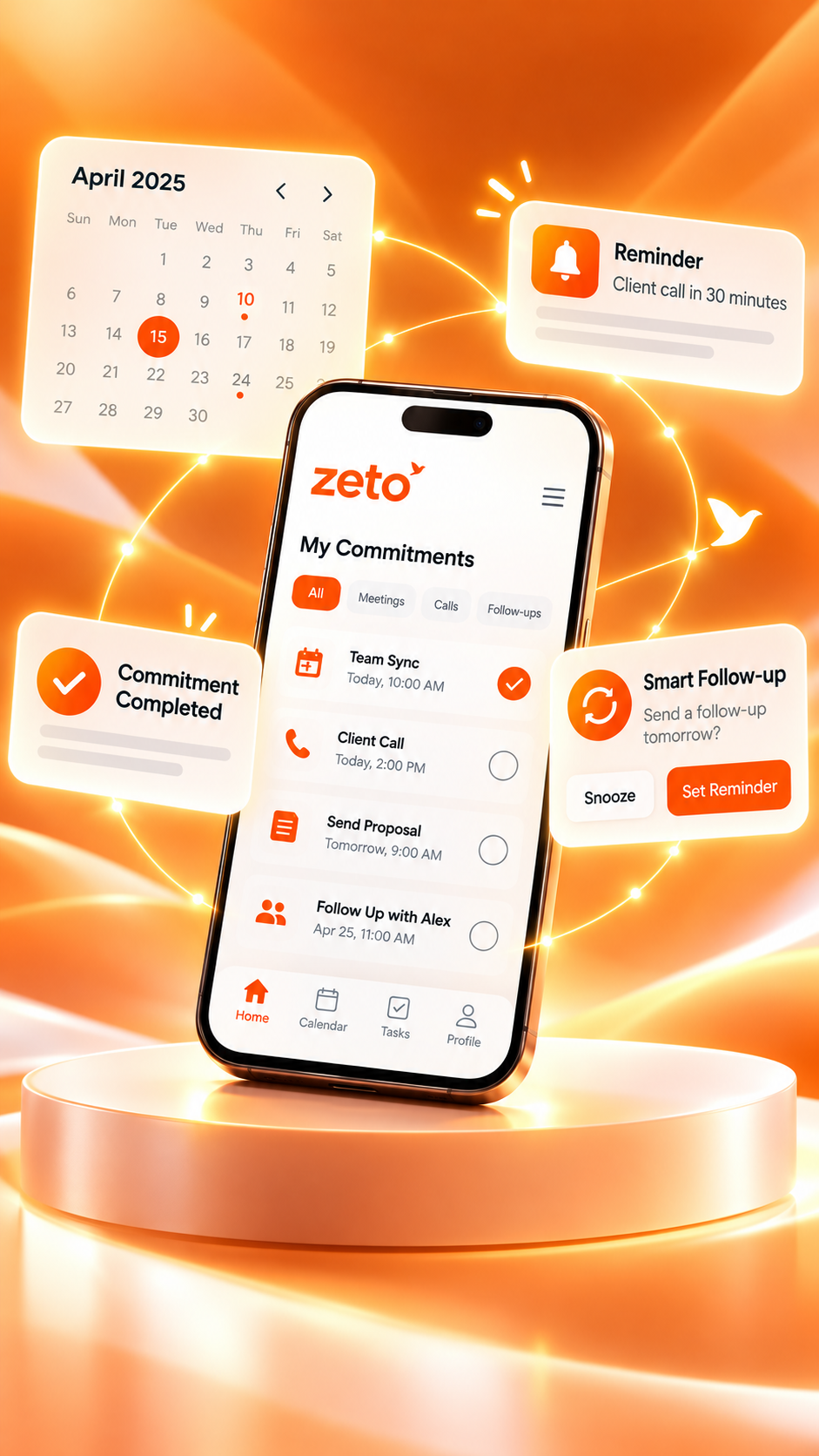
ZETO AI presents summaries, commitments, conversation search and follow-ups for eligible captured discussions. ZETO Enterprise provides a business-oriented view of daily activity, open commitments and customer signals. These features can support owners who need to understand what customers asked and what employees are working to resolve.
ZETO’s published materials also describe phone-call recording differences by device, so businesses should verify compatibility first. Conversations should be used with permission and appropriate employee awareness. The five-behaviour coaching model described on the Enterprise page is a proposed framework, not proof of an automatic employee-ranking system.
Start with a demo, one workflow and a small review sample before expanding.

Mistakes to avoid when introducing conversation intelligence
Do not deploy it as secret surveillance, do not treat an AI-generated “promise” as legally approved commercial terms, and do not make disciplinary decisions from incomplete excerpts. A missing recording may simply mean a conversation happened in a different channel.
For every high-stakes rate, payment condition or deadline, make a human confirm the original source and the approved document. An organized memory helps, but it is not a substitute for contractual and financial controls.
Understand the conversation behind the outcome.
Explore how ZETO Enterprise brings permitted customer discussions, open commitments and follow-up context into a clearer picture.
Frequently asked questions
What is conversation intelligence for small business?
It is a workflow that turns permitted conversation records into searchable summaries, open questions and follow-up context to support daily operations.
Does a small business need a large CRM first?
No. A focused conversation workflow can be useful on its own, although commercial records should still be maintained in an appropriate system.
Can conversation intelligence help with suppliers?
Yes, it can organize what was discussed and promised; confirm final dispatch and price details against supplier documentation.
Does ZETO AI work with every Android call recorder?
Compatibility varies by device and recording method. Confirm your own phone workflow and current app guidance before relying on call imports.
Can it handle Hindi and English conversations?
The published Android listing describes Hindi and English support. Accuracy can vary with audio quality, accents and mixed-language speech.
Can the owner view employee conversations without telling them?
Businesses should provide appropriate staff notice and use lawful, proportionate access controls. The published ZETO listing says team members are informed when joining.
Is it useful for businesses with only a few employees?
It can be, especially where conversations contain frequent customer commitments. Start with one workflow and measure whether it saves effort.
Can AI replace a quotation or purchase-order approval?
No. Approved business records and authorized people must confirm prices, payment terms and commercial commitments.
Sources and further reading
Product descriptions were checked against ZETO’s published pages. Examples and recommended processes are educational, not claims about live customer accounts or guaranteed results.
ZETO Enterprise overviewZETO AI AppZETO Android app descriptionGoogle’s people-first content guidance