Conversation Intelligence for Distributors, Manufacturers and B2B Sales Teams
B2B relationships are built across quotations, technical clarifications, dispatch updates and long buying cycles. Preserve the context that keeps those processes moving.
B2B conversation intelligence helps distributors, manufacturers and sales teams organize what customers requested, what suppliers or employees promised, and which actions remain open. The value comes from preserving context across departments while verifying commercial facts in the organization’s approved systems.
Why B2B conversations are harder to track
A typical consumer purchase can be straightforward. A B2B order may require a site inspection, technical specification, credit approval, delivery planning and multiple rounds of negotiation. Each conversation adds useful context, but that information often stays with the person who participated.
In industrial distribution, a customer may discuss price with sales, test results with a technical specialist and unloading arrangements with logistics. A manufacturer may coordinate an order across procurement, production, quality and dispatch. If details are copied into separate systems without the original meaning, teams can act on inconsistent assumptions.
Conversation intelligence is most valuable here as a way to preserve the thread of decisions and dependencies, not as a replacement for ERP, CRM or manufacturing controls.
Three industry workflows worth improving
Distributors: rates, stock and delivery terms
Distributors frequently revisit previously discussed rates, minimum quantities, freight, promised dispatch dates and payment terms. Searchable customer conversation history can shorten the time needed to locate what was said, while the approved quotation remains the source for final commercial terms.
Manufacturers: specifications and approvals
Manufacturing enquiries may involve drawings, material grade, quality acceptance criteria and revised production dates. A conversation summary can identify who requested a change and which technical approval is still required. It must not be treated as engineering sign-off.
Field sales teams: conversations across locations
A field representative may visit several plants and speak with procurement, maintenance and management on the same day. Structured notes and follow-up reminders can make the next visit more informed, while preserving which stakeholder said what.
Where customer context gets lost during a handoff
| Handoff | Common gap | Better question |
|---|---|---|
| Sales → technical | Customer need summarized too vaguely | What exact condition must the solution meet? |
| Sales → finance | Proposed term mistaken for approved credit | Who approved the term, and when? |
| Technical → production | Change request not tied to revision | Which specification version governs the order? |
| Production → dispatch | Partial availability becomes full-delivery promise | What quantity and date are confirmed? |
| Service → sales | Complaint resolved internally but customer not informed | Has the customer confirmed the resolution? |
These examples show why a “handoff completed” checkbox is not the same as an accurate transfer of context. The recipient needs the customer’s actual requirement, the latest decision and the next owner.
Example: an industrial flooring project with multiple dependencies
Imagine a fictional manufacturing customer seeking restoration of an existing factory floor. Sales discusses the scope and price, the technical team must verify surface condition, and operations must schedule work around a production shutdown. The customer asks whether the space will be available for forklift movement by Monday morning.
A weak handoff converts the discussion into “customer wants flooring this weekend.” A stronger handoff preserves the current surface condition, access constraints, pending technical assessment and the fact that Monday readiness is a question, not an approved guarantee.
The project leader can then confirm feasibility before sales promises a date. That prevents an unanswered technical question from becoming a commercial or operational commitment. This example illustrates the workflow; it is not a documented ZETO customer outcome.
A conversation-to-order handoff playbook
- Record or document the customer discussion through an approved, permission-based method.
- Create a summary that separates customer requirements, proposals, approved decisions and unresolved questions.
- Link the conversation to the correct customer, project and quotation reference in your business process.
- Name the owner and due date for each outstanding technical or commercial confirmation.
- Verify final terms against approved ERP, CRM, contract or drawing records before action.
- Confirm the customer was updated, then review repeated handoff gaps to improve the process.
B2B metrics that reveal useful progress
| Metric | What it reveals |
|---|---|
| Requirement-confirmation time | How quickly an unclear customer need becomes specific |
| Open commitment ageing | How long pending customer-facing actions remain unresolved |
| Handoff rework | How often another team must ask for missing details |
| Promise-kept rate | Whether verified customer commitments are completed as agreed |
| Repeat issue rate | Whether recurring customer concerns are being addressed at the root |
Track trends by workflow rather than turning an incomplete metric into a league table for employees. In seasonal or project-based B2B sales, a small number of large accounts can distort averages.
Review both successful and unsuccessful cases, and log the accuracy of AI classifications when using them to populate reports.
Where ZETO AI can support B2B teams
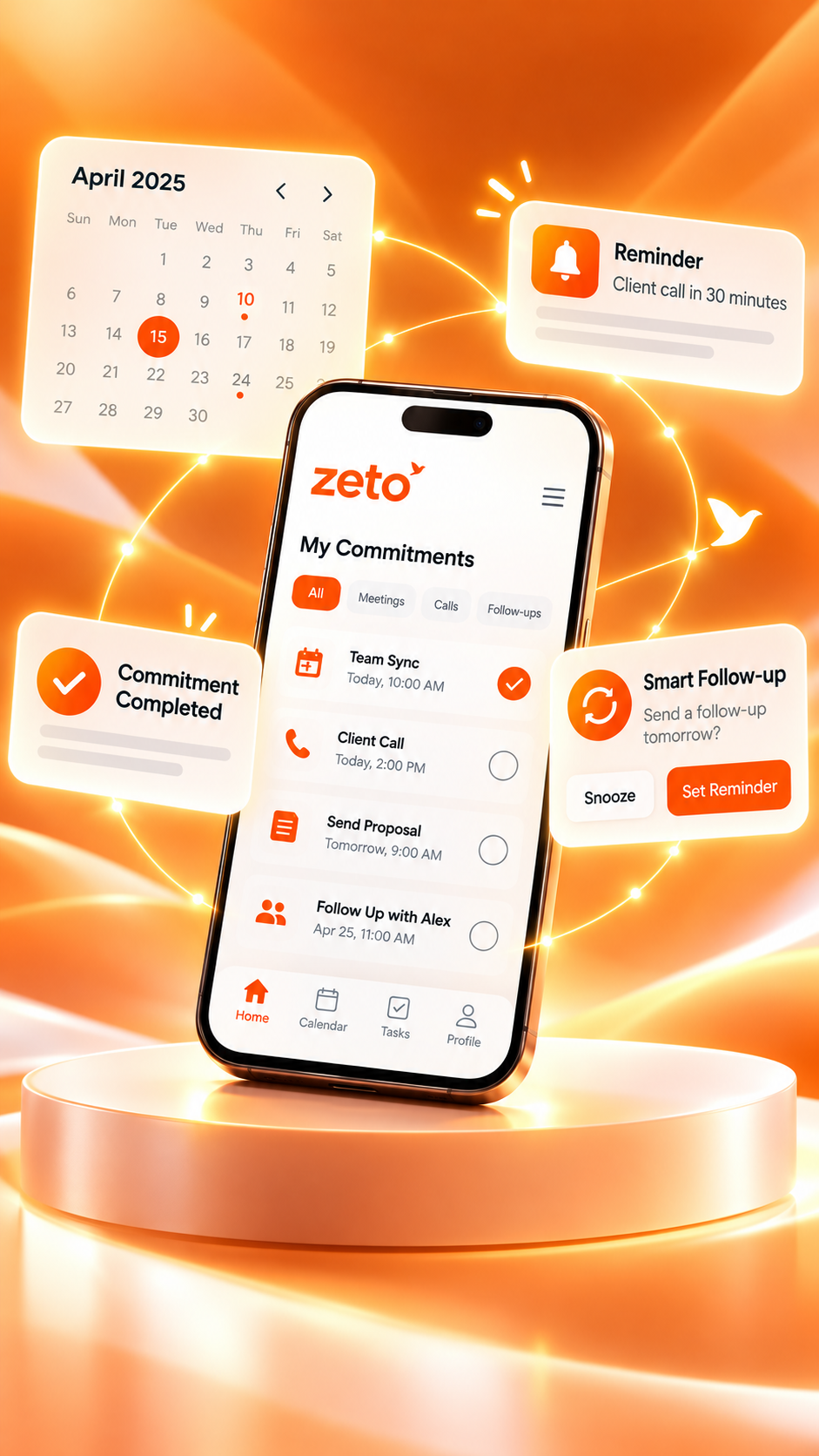
ZETO AI is positioned around eligible captured calls, meetings and voice notes, then summaries, commitments, reminders and answers from prior conversations. ZETO Enterprise adds leadership-facing workspaces around activity, customer signals and open follow-ups.
That makes the platform relevant to the information layer of B2B sales: what a customer asked, which team is responsible and what needs attention. It does not mean the platform has been verified to control inventory, issue invoices, approve engineering changes or integrate directly with every business application.
For a practical pilot, choose one high-friction handoff—such as quotation clarifications or dispatch changes—then review evidence quality, employee awareness, customer outcomes and time saved before extending the process.

Protect customer and employee trust
Industrial conversations can include sensitive purchase rates, production plans, drawings or customer identities. Establish explicit rules for recording, access, retention and export. Restrict sensitive commercial records to authorized users.
Always verify an AI-generated statement before making decisions that affect contractual commitments, pricing, safety or employee performance. AI is most valuable when it helps people find the relevant evidence and ask better questions.
Understand the conversation behind the outcome.
Explore how ZETO Enterprise brings permitted customer discussions, open commitments and follow-up context into a clearer picture.
Frequently asked questions
What is B2B conversation intelligence?
A way to organize permitted business conversations so teams can find requirements, commitments, context and open questions across a longer sales cycle.
How can distributors use it?
To revisit discussions about rates, quantities, stock and delivery terms while checking final decisions against approved quotations or orders.
Is conversation intelligence useful for manufacturing sales?
Yes, especially for preserving technical clarifications and ownership. It is not a replacement for drawings, quality approvals or engineering sign-off.
Does it replace an ERP or CRM?
No. It can complement those systems with conversation context; inventory, financial and order records must remain in their approved systems.
What should a B2B sales summary contain?
The customer requirement, relevant project, decisions, proposed terms, open questions, responsible owner and the next due action.
Can ZETO AI track every customer conversation automatically?
Capture and imports depend on the source, device and permissions. Businesses must check coverage rather than assume every conversation was recorded.
How should teams evaluate a pilot?
Measure missing handoff details, verified open commitments, resolution times and user correction effort before deciding whether to expand.
Can AI summaries be used as proof of employee misconduct?
They should not be treated as standalone proof. Review lawful source access, full context, employee explanations and verified outcomes.
Sources and further reading
Product descriptions were checked against ZETO’s published pages. Examples and recommended processes are educational, not claims about live customer accounts or guaranteed results.
ZETO Enterprise overviewZETO AI AppZETO Android app descriptionGoogle’s people-first content guidance