Before You Blame an Employee, Understand What Actually Happened
When a deadline slips or a customer complains, the most useful first question is not “Who is responsible?” It is “What happened between the original conversation and the final result?”
A customer is upset. A delivery date was missed. A sales follow-up never happened. The report points to an employee, and a manager naturally wants an explanation. But the name beside an overdue task is not necessarily the full story.
Perhaps the employee misunderstood the original request. Perhaps the customer changed the scope. Perhaps the work was completed internally, but nobody updated the customer. Or perhaps the commitment was clear and the employee genuinely failed to follow through. These situations look similar on a dashboard, yet each requires a different response.
Effective leadership begins by separating the observed result from assumptions about its cause. With the right conversation context, a manager can move from frustration to a clearer, fairer discussion about what needs to improve.
Why blaming an employee too quickly can make the real problem worse
Leaders are accountable for outcomes. When something goes wrong, they have to act. The risk comes when a disappointing outcome is treated as proof of carelessness, poor attitude or lack of ability before the underlying events have been checked.
Imagine that a manager hears, “The client never received the revised quotation.” One assumption is that the salesperson forgot. Yet the quotation might have been waiting for pricing approval, or the customer might have requested a different material after the first call. Without that information, the response could target the wrong person or the wrong problem.
State what is known: “The customer did not receive the revised quotation by Thursday.” Then investigate why. Do not turn an outcome into a judgment about someone’s character without evidence.
Quick blame can discourage employees from raising blockers early. It can also leave operational problems untouched, so the same failure appears again with another employee. Understanding what happened does not remove accountability; it makes accountability more accurate.
Was it an employee mistake, an unclear instruction or a broken process?
A missed commitment can have several contributing causes. Managers should examine the employee’s actions and the conditions under which the work was expected to happen.
| What the report shows | What may have happened | What to verify |
|---|---|---|
| Customer callback overdue | The owner or expected time was never confirmed | Was a specific callback promised? Who accepted it? |
| Quotation delayed | Pricing approval or technical information was missing | What was requested, escalated and approved? |
| Customer complaint | Expectations were different on each side | What did the customer understand would happen? |
| Repeated handoff failure | Teams lack a clear transfer or update process | What information reached the next person? |
| Individual follow-through gap | A clear commitment was accepted but not completed | What reminders, obstacles and updates existed? |
Sometimes the answer is a combination. An employee might have missed an update while another department caused the underlying delay. Fair reviews make room for more than one contributing factor—and distinguish what was within the employee’s control.
The instruction or customer requirement was misunderstood.
The next step did not have a confirmed owner or deadline.
Approvals, staffing, tools or handoffs prevented completion.
A customer complaint that changed meaning when the timeline was reviewed
Consider a fictional example from a B2B company. A customer says their order update was never delivered. The operations manager sees an overdue commitment under a sales executive’s name and calls the executive into a meeting.
“You promised Friday. Why did you let the customer down?”
That would be an understandable reaction if the manager only saw the late task. But the call history, internal messages and delivery records may tell a more precise story.
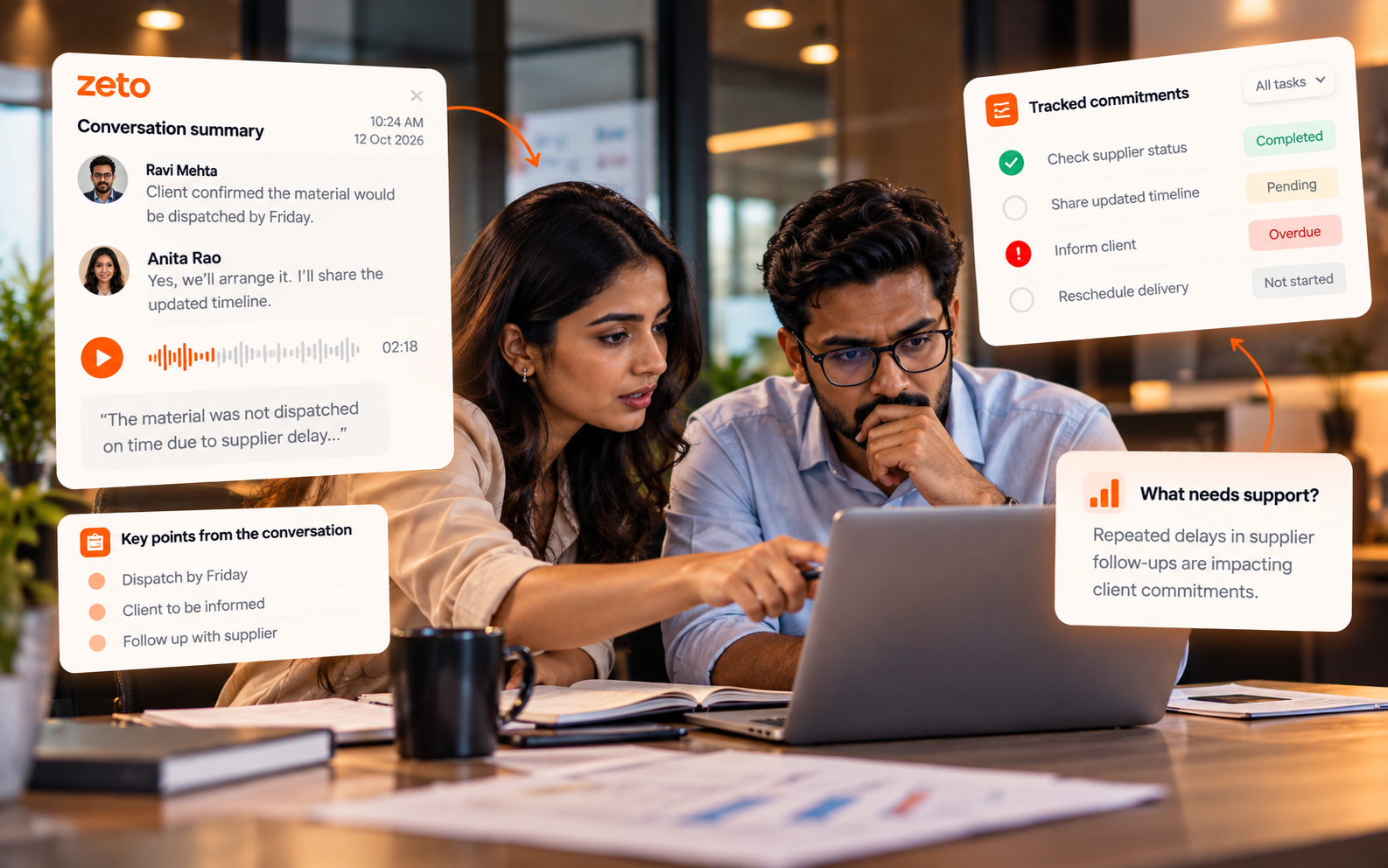
The customer asks for confirmation that material can arrive by Friday. The salesperson says they will check stock and revert—not that Friday delivery is confirmed.
The employee requests stock availability. An internal team says dispatch depends on supplier confirmation. No clear deadline for that confirmation is recorded.
The employee learns that delivery is unlikely but does not update the customer immediately. The customer still expects a response before Friday.
The customer complains about the lack of an update. The issue is partly a supply dependency and partly a missed communication responsibility—not simply a broken delivery promise.
Now the coaching discussion becomes more useful. The manager can address the lack of a timely customer update, improve the supplier-confirmation handoff and define when uncertain delivery dates must be escalated. The employee is still accountable for communication, while the organization also owns its process problem.
“What did we actually promise, when did we know the plan had changed, and how could we have updated the customer sooner?”
The lesson is not that a recording always proves someone right. It is that the sequence of discussions, approvals and actual outcomes can make the investigation more precise.
Six questions every manager should ask before deciding what went wrong
What was the original requirement?
Identify the customer’s actual request, including conditions, quantities, dates and unresolved details.
What did the employee agree to?
Check the exact commitment. A promise to check is different from a promise to deliver.
What depended on other people?
Look for approvals, stock, technical inputs, staffing or other decisions outside the employee’s control.
What updates were provided?
Review whether the customer and colleagues were informed when conditions changed.
What was the verified outcome?
Compare the conversations with completed work, customer feedback and reliable business records.
What does the employee add?
Give the person a meaningful opportunity to provide missing context or correct an inaccurate record.
These questions allow a manager to distinguish evidence from speculation. They also lead to more specific instructions: clarify ownership, train the right skill, remove a blocker or address a genuinely missed responsibility.
How to review a workplace problem without jumping to conclusions
A constructive review can be simple. It does not need to become an investigation into everything an employee has ever said. Focus on the relevant incident and information the manager is authorized to access.
- Describe the incident neutrally. Write down the missed deadline, unresolved request or customer complaint without assigning motive.
- Find the relevant conversation. With proper permission, review the meeting or call where the requirement and next step were discussed.
- Build a short timeline. Note the agreed action, owner, expected date, handoffs, changes and confirmed updates.
- Check independent records. Cross-check the summary against the actual order, quotation, task status or customer response. Automated transcription can miss details.
- Hear the employee’s account. Ask about obstacles, uncertainty, workload and missing information before forming a conclusion.
- Agree on one clear improvement. Specify the next action, support required, owner and review date. Observe whether the issue improves over time.
A good review should answer two questions: “What can this person do differently?” and “What must the business change so the problem does not repeat?”
Different problems need different coaching—not a generic warning
A leader who understands the root cause can select a targeted response. If the problem is unclear communication, practice confirming requirements. If commitments are repeatedly accepted without follow-through, improve ownership and planning. If priorities suddenly change, support adaptability. If work stalls at handoffs, examine execution and operations together.
The proposed ZETO Enterprise five-behaviour development framework organizes these conversations around the following areas. The framework should not be confused with a released automatic five-factor employee scoring feature.
These are discussion lenses, not labels to attach to a person. An individual can communicate well yet be blocked by a supplier. Another may complete a task but fail to explain its status to the customer. The right support follows the actual need.

How ZETO Enterprise helps leaders see the story behind an outcome
ZETO Enterprise is designed to bring permitted business conversations and relevant follow-ups into a clearer view. Its current Enterprise experience includes workspaces for overall activity, customer signals, people context, daily reports and AI-assisted questions.
Instead of relying only on a complaint count or an overdue task, leaders can review what was discussed, which commitment was captured and whether the next step is still unresolved. Where access permits and the source is available, an AI search feature can help locate the earlier conversation that matters.
Conversation summaries
Bring important requests, decisions, promises and relevant details into an organized reference.
Follow-up visibility
Review open commitments and customer updates alongside daily activity rather than looking only at call volumes.
Customer context
Reconnect a customer concern with what was discussed and what was expected to happen.
Better coaching conversations
Use relevant evidence to decide what to clarify, support or improve, with the person involved in the discussion.
The product’s existing Excellence and My Progress views also display selected indicators such as communication, ownership and discipline, with coverage or confidence context. Such indicators can guide review, but they are not proof of intent, character or every cause behind an outcome.
ZETO does not replace management judgment. Managers remain responsible for checking source material, hearing the employee’s explanation and applying an appropriate process before making employment decisions.
Conversation intelligence should make reviews fairer—not turn work into constant surveillance
Better visibility comes with responsibility. Work conversations may contain personal or sensitive information, and transcripts or AI summaries can be incomplete. Organizations should define legitimate purposes, use appropriate notice or consent, follow applicable requirements and limit access to authorized people.
Collect what is necessary. Review only relevant, permitted work conversations and retain information according to a clear policy.
Validate the evidence. Check original context and independent outcomes rather than relying on a transcript excerpt, sentiment label or AI-generated score.
Give people a voice. Make room for employee explanations, correction of errors and a fair review process.
Make people decisions human-led. Coaching, recognition, role changes or disciplinary decisions should not be delegated to an AI summary.
A balanced system gives employees clarity about expectations, helps managers recognize strong work and makes recurring process failures easier to address. It should strengthen trust and accountability together.
A quick checklist before your next performance discussion
- I can describe the actual result without assuming why it happened.
- I know what the customer or colleague originally requested.
- I have checked the accepted commitment, owner and expected deadline.
- I have reviewed relevant handoffs, dependencies and changed circumstances.
- I have compared conversation evidence with verified work outcomes.
- I have given the employee an opportunity to explain the situation.
- We can agree on a practical next step and the support needed to achieve it.
When these points are clear, the conversation changes. Instead of simply asking why someone failed, a leader can identify the specific behaviour, decision or process that deserves attention.
Frequently asked questions
Why should managers understand what happened before blaming an employee?
A missed outcome does not reveal every contributing cause. Reviewing the original instruction, dependencies, updates and result helps distinguish a genuine follow-through issue from unclear expectations or operational constraints.
Can conversation intelligence show why a customer complained?
It can help a manager review a relevant, authorized customer conversation, including what was asked and promised. The original recording, surrounding circumstances and verified customer outcome still need to be checked before deciding on the cause.
How is conversation intelligence different from a performance report?
Reports summarize measured activity or outcomes. Conversation intelligence adds context from relevant discussions, such as commitments, concerns and next steps. The two should be evaluated together.
What should a manager do if the employee says the report is wrong?
Review the source records, data coverage and supporting work documents. Ask for the employee’s explanation, correct confirmed inaccuracies and avoid taking action based on a disputed or unverified summary.
Does ZETO Enterprise automatically decide whether an employee should be trained or replaced?
No. Employment and coaching decisions belong to people. ZETO helps organize permitted work conversations and relevant follow-ups; the manager must verify the context and apply fair judgment.
What are the five workplace behaviours discussed by ZETO?
The proposed people-development framework considers Communication, Ownership, Discipline, Adaptability and Execution. An automatic scoring system for that complete five-behaviour framework is proposed, not a released feature.
Can managers use recorded calls without telling employees?
Organizations should follow applicable recording, privacy and employment requirements, provide appropriate notice or consent where required and limit access to authorized users. Hidden or indiscriminate monitoring is not a responsible substitute for fair management.
How can leaders check whether coaching worked?
Agree on a specific improvement and a review date. Compare subsequent permitted conversations and documented actions with verified customer or team outcomes, while considering changing circumstances.
Better people decisions start with a clearer picture.
Understand customer requests, promises and follow-through before deciding what needs to change. Explore how ZETO Enterprise brings permitted conversations and work context together.