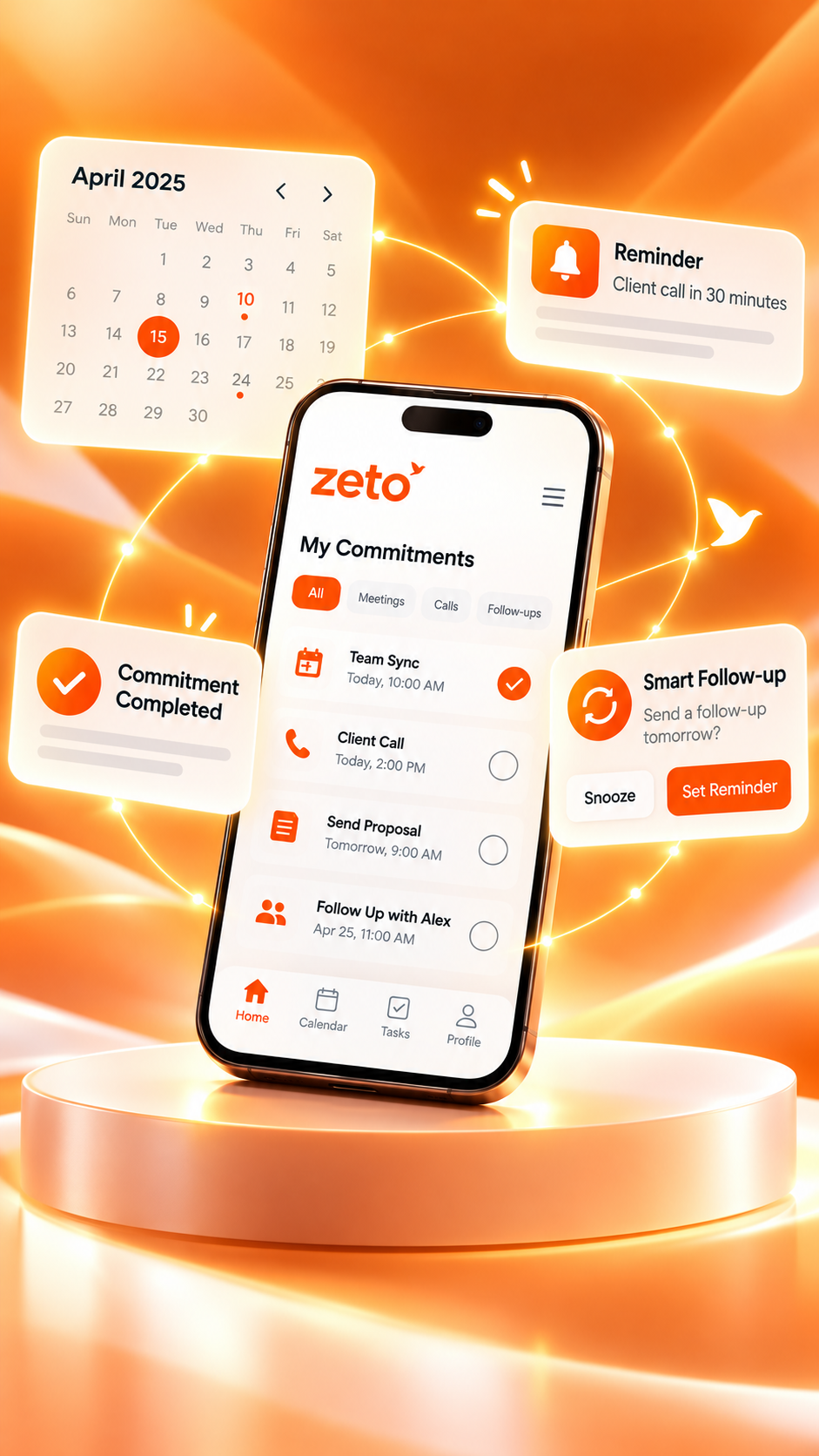
From Conversations to Actions: The Future of Personal AI Assistants
The important part of a conversation is often what happens after it. Discover how personal AI assistants can help turn spoken decisions, responsibilities and promises into the next meaningful step.
The conversation is the beginning. Progress is the outcome.
Keep a permitted record
Identify key details
Separate decisions from ideas
Track the next step
Find context later
A useful model for personal AI assistance. Recording and action capabilities vary by product and device.
The most important part of a conversation often happens afterward.
A meeting ends with a decision. A customer call ends with a promise. A supplier discussion ends with a revised delivery date. But unless those details make their way into everyday work, even a productive conversation can lead to very little progress.
Professionals spend significant portions of their working day speaking with customers, colleagues, suppliers and partners. Every conversation may contain a requirement, a risk, a question that needs answering or an action someone has agreed to take. The challenge is not simply remembering that the discussion happened. It is remembering what changed, who is responsible and what happens next.
For years, personal productivity tools have focused on notes, lists and calendar events. Those remain useful, but they often depend on someone manually transferring spoken information into another system. Personal AI assistants point toward a different experience: a more connected path between the conversation and the work that follows.
Why does follow-through break down after a conversation?
A conversation feels clear while everyone is present. Minutes later, however, the participants move on to another call, project or urgent issue. What was agreed can be affected by several small gaps.
Details get forgotten
Names, prices, technical requirements and deadlines compete for attention. The person who remembers the main point may still miss a crucial condition.
Ownership is uncertain
“We will handle it” sounds reassuring, but it may not establish exactly who will complete the work or when.
Decisions get mixed with ideas
A tentative suggestion can later be remembered as a confirmed decision, especially across multiple discussions.
Context becomes difficult to find
By the time someone checks the promise, the discussion is buried among messages, notes and earlier recordings.
These problems do not necessarily mean that people are careless. Often, the information has simply been separated from the task that depends on it. A useful assistant helps bridge that gap while leaving people in control of the final interpretation.
What is a personal AI assistant for conversations and actions?
A personal AI assistant is software that helps a person complete information-related tasks using artificial intelligence. Depending on the product, this can involve interpreting written requests, summarizing material, organizing tasks, answering questions or supporting workflows.
In conversation-led work, the assistant becomes more relevant when it can understand information from permitted calls, meetings, voice notes or typed notes. Instead of acting only as a place to store content, it helps identify useful details: what was discussed, what was decided, which promises were made and which questions remain open.
There is a distinction worth keeping clear. Recording a conversation is not the same as understanding it, and understanding it is not the same as completing an action. An AI system may be able to propose or organize follow-ups without actually sending a document, making a payment or contacting a customer. Those real-world actions must still be performed by the right person or by an explicitly authorized workflow.
How can AI turn everyday conversations into useful actions?
The process is easier to understand when broken into a small set of connected steps. Not every app supports every step, but together they illustrate what conversation-driven personal assistance can look like.
Capture the conversation appropriately
Start with a meeting, voice note, typed note or a call recording saved through a supported method. Permission, transparency and device compatibility matter. If a discussion is never captured, the assistant cannot reliably remember it later.
Convert speech into understandable information
Speech recognition can create text from audio, while AI can organize the conversation into topics, summaries, decisions and unresolved questions. Important names, dates and numbers still need checking.
Identify commitments and clarify responsibility
A phrase like “I will send the revised quotation on Thursday” contains a possible task, owner and due date. An assistant can surface these fields, but ambiguous statements should be confirmed with the people involved.
Keep follow-ups visible at the right time
Useful task views and reminders bring attention back to pending commitments. This makes it easier to move from “we discussed it” to “someone is taking the next step.”
Retrieve the original context when needed
Days later, a user may ask what was promised, why a deadline changed or which requirement a customer confirmed. Source-linked answers can help the user review the record before acting.
A customer call should not end as a forgotten promise.
Imagine a project consultant speaking with a customer on Monday. The customer requests a revised proposal with a smaller first phase. The consultant agrees to send the updated document by Thursday, while the customer promises to share the final site measurements on Tuesday.
Without a dependable record, the consultant may remember the proposal but forget the dependency. On Thursday, the document is delayed because the measurements were never received. The real problem was not necessarily the discussion—it was the missing connection between the two commitments.
Customer wants a revised proposal covering a smaller first phase of the project.
Proceed with preparing the revised proposal once the final site measurements are received.
Share final measurements by Tuesday. Owner: customer.
Send the revised proposal by Thursday. Owner: consultant.
Have the measurements arrived? If not, confirm the revised handover timeline rather than assuming Thursday is still possible.
This example shows why the action layer matters. A summary alone can document that everyone had a productive call. A follow-up view draws attention to who owes what, which task depends on another and what needs to happen next. The users remain responsible for confirming the details and completing the work.
How is an action-focused AI assistant different from notes, recordings and reminders?
Traditional productivity tools remain essential, but they often solve one part of the workflow at a time. A notebook stores observations. A voice recorder preserves audio. A calendar shows appointments. A task manager tracks assigned work. A conversation-aware assistant can help connect these information sources.
Information across tools
- Record the meeting in one app
- Write decisions separately
- Re-enter promises into a task list
- Search old notes when someone asks why
Conversation to next step
- Capture a supported discussion
- Review a structured summary
- Check extracted responsibilities and dates
- Return to source context when needed
The advantage is not that AI makes notes or reminders obsolete. It is that a well-designed system can reduce the manual handoffs between them. The extent of that benefit depends on the tool's actual capabilities and the quality of the information it receives.
Who can benefit from conversation-driven AI assistance?
Business owners
Revisit supplier terms, customer requests and promises without relying only on recollection.
Sales professionals
Keep track of objections, agreed next steps and the context behind customer follow-ups.
Consultants and freelancers
Turn discovery calls and project updates into clearer deliverables and timelines.
Project teams
Review shifting requirements, dependencies, approvals and outstanding questions.
The common benefit is continuity. When a professional returns to a customer after several days, they can start with the relevant context instead of asking the same questions again. That continuity can also support better teamwork when information is shared only with the people who are authorized to see it.
Where is the future of personal AI assistants heading?
Much of the public conversation about AI focuses on its ability to answer a question or generate text. A more useful direction for everyday work is for assistants to help people maintain context across time and understand how earlier discussions relate to current responsibilities.
More context, less repetition
Future assistants may become better at recognizing that a customer request in today's call relates to a decision made last week. This could reduce repetitive explanations while helping people notice changed requirements.
Better separation of proposals and confirmed decisions
An important design challenge is distinguishing “we might do this” from “we agreed to do this.” Systems that communicate uncertainty clearly—and let users check the original source—are likely to be more useful than systems that present every suggestion as a fact.
Stronger connections between information and workflows
With appropriate permissions, assistants could increasingly connect conversation-derived tasks to the calendars and work tools people already use. These are possible industry directions, not promises that every current AI assistant or ZETO feature performs such integrations today.
More human control, not less
Personal AI assistants will earn trust through useful boundaries: showing evidence, asking for confirmation when meaning is unclear, handling sensitive information responsibly and allowing the user to correct mistakes.
ZETO AI: from conversations to meaningful progress.
ZETO AI is built around the idea that work conversations should remain useful after they end. Its published app descriptions explain how supported meetings, voice notes, notes and, on compatible Android phones, call recordings saved by the phone's own calling app can become summaries, recorded decisions and organized follow-ups.
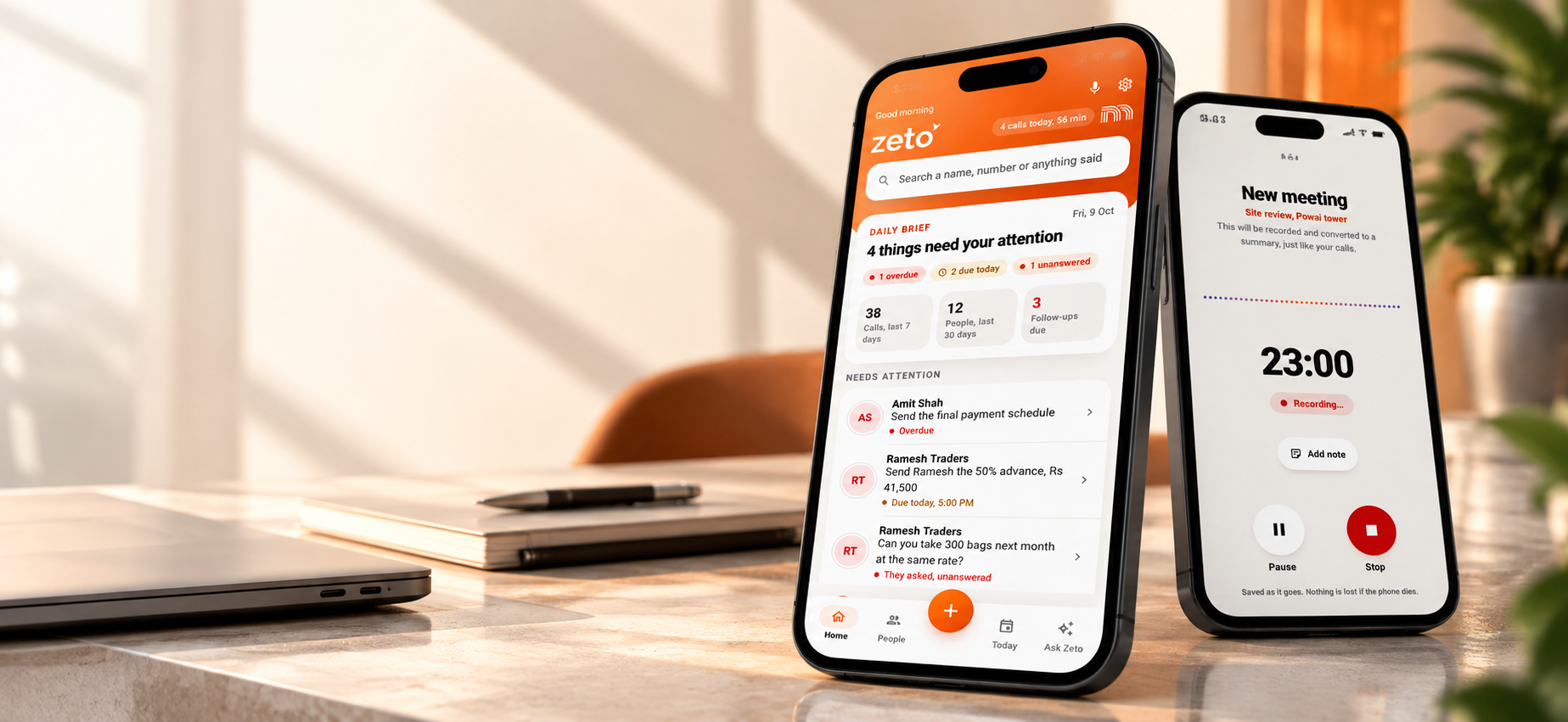
Ask Zeto lets users ask questions about conversations they have already made available to the app, such as what someone agreed or which promises remain open. The answer is designed to show its source, making it easier to check important context. ZETO also provides a Today view for pending and overdue follow-ups, as described in its app listings.
One point matters when discussing recording: ZETO does not itself record ordinary phone calls. Supported Android calling apps may save call recordings that ZETO can then process, subject to device capabilities and local requirements. Meeting, voice-note, note and import functions follow their own supported workflows, which may differ across platforms.
The wider idea also connects to ZETO Enterprise, where permitted work conversations and follow-ups can help leaders understand what was discussed, promised and completed. That context should inform, rather than replace, fair human judgment.
What ZETO is intended to help with: remembering conversations, understanding important details, checking commitments and finding the information needed for the next action.
How do you use a personal AI assistant responsibly?
Conversation-based AI can be useful only when people trust how their information is handled. Before capturing a call or meeting, follow applicable recording laws and workplace policies, give any required notices and obtain any required consent. Do not assume that a participant has agreed to recording simply because a tool makes it easy.
AI-generated summaries can miss nuance or mishear numbers, names and technical terms. A promise may be conditional, or a later correction may change the meaning of an earlier statement. For important payments, contractual terms, employee matters or customer commitments, return to the source and verify the details with the relevant people.
Look for clear information about data use, available permissions, retention and deletion. ZETO's privacy policy explains its published data-processing approach. Always use the tool within your organization’s policies and the capabilities available on your device.
- Capture appropriately. Record only when permitted and when the participants have been informed as required.
- Review extracted tasks. Confirm owners, dates, conditions and dependencies before relying on them.
- Use source-based answers. Check consequential facts against the actual discussion.
- Protect access. Share conversation information only with authorized people.
- Keep the person accountable. An assistant can surface a commitment; the responsible person still needs to fulfill it.
Common questions about the future of personal AI assistants.
What is the difference between an AI assistant and an AI note-taker?
An AI note-taker focuses on capturing or summarizing information. A broader personal AI assistant may also help organize follow-ups, find past context and connect information to next steps, depending on the product.
Can AI turn meeting conversations into tasks?
Some products can identify action items, possible owners and due dates from supported recordings or notes. Ambiguous responsibilities and deadlines still need human confirmation.
Can personal AI assistants remember previous calls?
They may retrieve details from previously captured or imported conversations that the user is authorized to access. They cannot reliably remember discussions that were never saved or provided.
Does an AI assistant automatically complete every action it finds?
No. Organizing a reminder or identifying an action item is different from sending a proposal, approving payment or completing a task. Actual execution depends on the tool, its permissions and the people involved.
How does ZETO AI help manage follow-ups?
ZETO's published app descriptions say it organizes promises and follow-ups from supported conversations, including a Today view for due and overdue items. Always review the extracted details for accuracy.
Does ZETO record ordinary phone calls automatically?
No. Where supported, the app processes recordings that the phone's own Phone app has saved. Recording and import support varies by device and platform, and recording laws still apply.
Will personal AI assistants replace human decision-making?
They are better understood as support tools. AI can help people find information, organize follow-ups and identify uncertainty, but important decisions remain the responsibility of the people with the relevant context and authority.
The future is not just remembering more. It is following through better.
When people speak about the future of AI assistants, it is tempting to focus on futuristic interfaces and impressive automation. But the real value of an assistant can be much simpler: helping someone remember what a customer requested, find a decision from last week, recognize a pending commitment and take the next step with confidence.
From conversations to actions is a shift in how we think about workplace information. A good conversation becomes a usable record. A usable record supports a clear task. A clear task supports progress that people can understand and verify.
Every conversation can lead to a clearer next step.
Explore how ZETO AI helps professionals keep useful details, follow-ups and answers connected to the conversations that created them.