How AI Meeting Summaries Help Professionals Remember Important Decisions
Meetings create ideas, decisions and commitments. An AI-powered summary helps turn those conversations into a clear record of what matters—and what needs to happen next.
What was discussed?
What was actually decided?
Who is doing what, and by when?
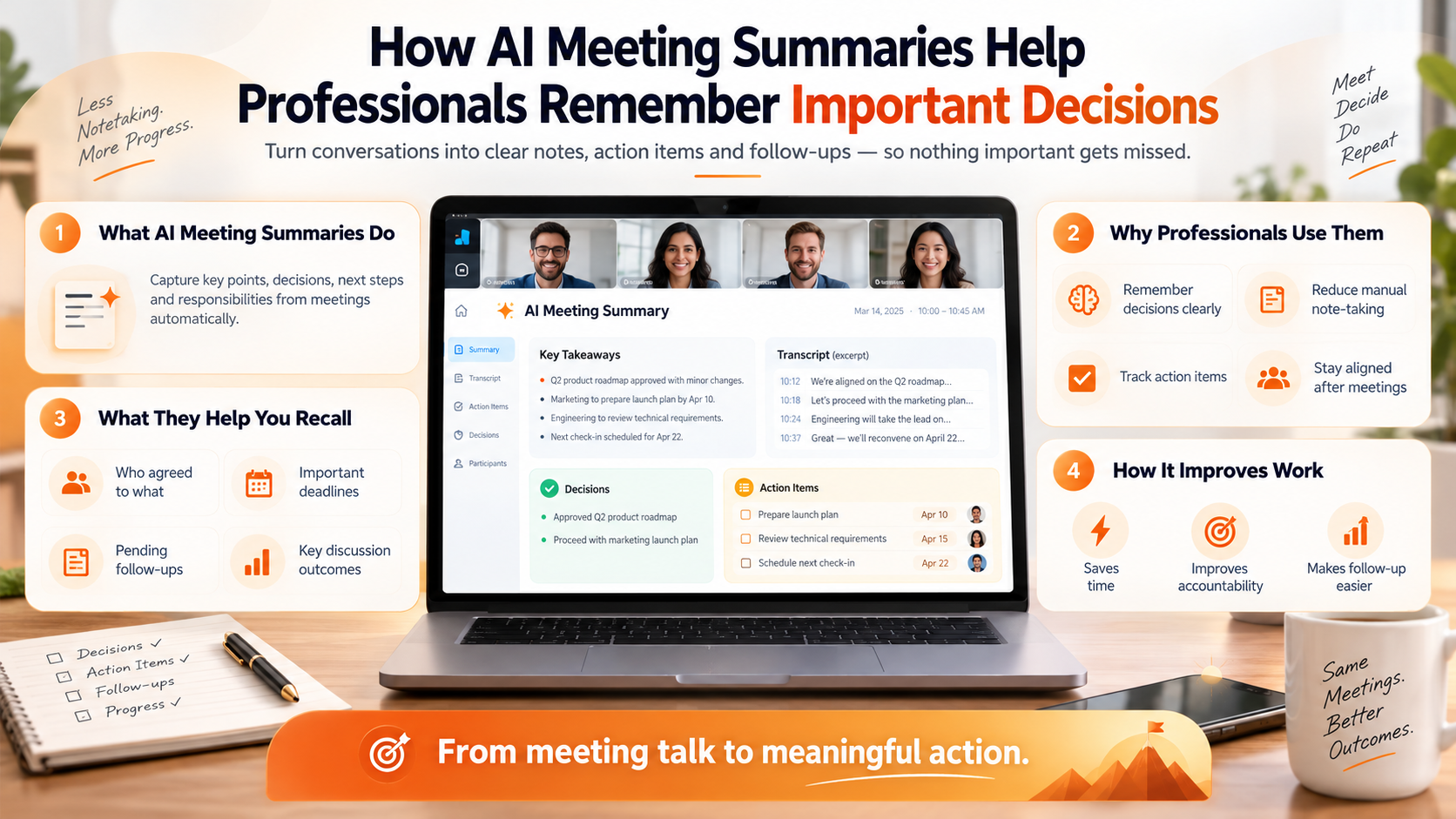
A useful summary keeps discussion, decisions and next steps distinct.
From talk to action: how AI meeting summaries work.
Important decisions often disappear into the meeting.
A productive meeting can still leave people uncertain. Everyone may remember the general discussion, but not the exact decision, the final deadline, or who agreed to take responsibility.
Think about a project review on Monday. A customer requirement changes. A delivery date is discussed. Someone mentions a pricing revision, while another person volunteers to send the updated proposal. By Thursday, people remember different versions of the conversation. The team searches through personal notebooks, chat messages and calendars to reconstruct what happened.
The problem is not necessarily that people were inattentive. Meetings contain interruptions, competing viewpoints, details that change in real time, and multiple action items. A useful written record reduces the need to rely on individual memory alone.
What is an AI meeting summary?
An AI meeting summary is a structured overview of a meeting created with the help of artificial intelligence. Depending on the tool, AI may work from a recording, an imported audio file, a transcript, or notes supplied by a participant. It identifies the principal subjects discussed and presents them in a more readable format.
Unlike a word-for-word transcript, a summary is designed to save time. A strong summary separates discussion points from decisions, action items, unanswered questions and important context. It should make it easier to understand the outcome without replaying the entire conversation.
“I think we agreed…”
- Personal notes differ
- Deadlines are uncertain
- Owners are not always named
- Old discussions take time to revisit
“Here is what we agreed.”
- Important points in one place
- Explicit decisions highlighted
- Next steps and owners recorded
- Context easier to retrieve later
AI does not guarantee that every detail is correct. A summary is a helpful first draft that participants should review—especially where financial terms, customer promises, legal matters or exact dates are involved.
How AI meeting summaries work, step by step.
Different products use different methods, but the process usually follows four stages:
Capture the conversation
With appropriate notice, permissions and consent, a meeting can be recorded using a supported method. Some tools also accept an existing audio file, transcript or typed notes.
Convert spoken words into usable text
Speech-recognition technology converts the audio into text. This gives the AI something to analyze, though accuracy can vary with noise, accents, speaker overlap and technical terminology.
Identify what matters
The system organizes the discussion into themes, takeaways, explicitly stated decisions, promises and pending questions. People should verify any interpretation that may be ambiguous.
Make next steps easier to review
Action items, names and dates can be collected into a follow-up list. The summary becomes a reference that people can revisit before their next call or project review.
One meeting. Several decisions. A clearer way forward.
Imagine a 25-minute meeting between a sales representative, a project manager and a customer. The team discusses a revised quotation, delivery feasibility and an upcoming site visit. Without structured notes, the participants may leave remembering different details.
The customer wants a revised quotation and confirmation of the proposed installation schedule.
The team agrees to prepare an updated proposal before confirming the final work schedule.
Sales representative: send the revised quotation by Wednesday, 4 PM.
Project manager: confirm site readiness and share any constraints by Thursday.
The customer has not yet approved the updated quotation or committed to the final installation date.
Notice the distinction: the revised quotation is an assigned task, while the installation date remains unconfirmed. A good summary should not present an open question as a completed decision.
When that customer calls again, the team can return to the actual discussion instead of reconstructing the meeting from memory. The same record can help prepare the next agenda and check whether previous commitments were completed.
How AI meeting summaries help busy professionals.
AI summaries are useful when they improve the way decisions are understood, communicated and revisited—not simply when they produce text more quickly.
Less time reconstructing conversations
A concise record helps professionals review the outcome without searching through scattered notes or listening to an entire recording.
Clearer ownership
Action items are more useful when the responsible person and expected timing are visible rather than implied.
More consistent client follow-ups
Sales and service teams can return to customer requirements, agreed terms and unanswered questions before their next conversation.
Smoother team handovers
Colleagues joining a project can understand the relevant meeting context without relying entirely on second-hand explanations.
Better meeting preparation
Teams can open the previous summary to review unfinished actions and build the next agenda around actual progress.
A searchable history of decisions
When summaries are stored and searchable, it becomes easier to locate past agreements rather than guessing when something was discussed.
What makes an AI meeting summary genuinely useful?
A polished-looking summary is not always a reliable summary. Before your team begins using one to make decisions, check whether it captures the details that matter in your work.
- Meeting purpose: What issue or decision brought everyone together?
- Key context: Which requirements, numbers, conditions or concerns were raised?
- Decisions: What was expressly agreed, rather than merely suggested?
- Action items: Who owns each next step, and is a deadline stated?
- Open questions: Which topics need confirmation, approval or another discussion?
- Evidence and accuracy: Can people check uncertain points against a transcript, recording or original notes?
One essential habit: review the AI-generated summary before circulating it as the official meeting record. Correct names, figures and dates, confirm decisions with the relevant participants, and avoid treating guesses as established facts.
Who benefits most from meeting summaries?
For business owners, meeting summaries help keep supplier commitments, customer expectations and internal decisions more organized. For sales professionals, they make it easier to revisit objections, agreed next steps and quotation requests. For project managers, they support more consistent tracking of decisions, dependencies and responsibility across site reviews and progress meetings.
Consultants and client-facing teams can use summaries to prepare for the next discussion without losing context. Operations teams can refer to prior handovers or coordination calls when checking why a task is blocked.
The shared benefit is continuity. Even when people are busy or a new colleague takes over, important context is easier to recover.
From meeting notes to action with ZETO AI.
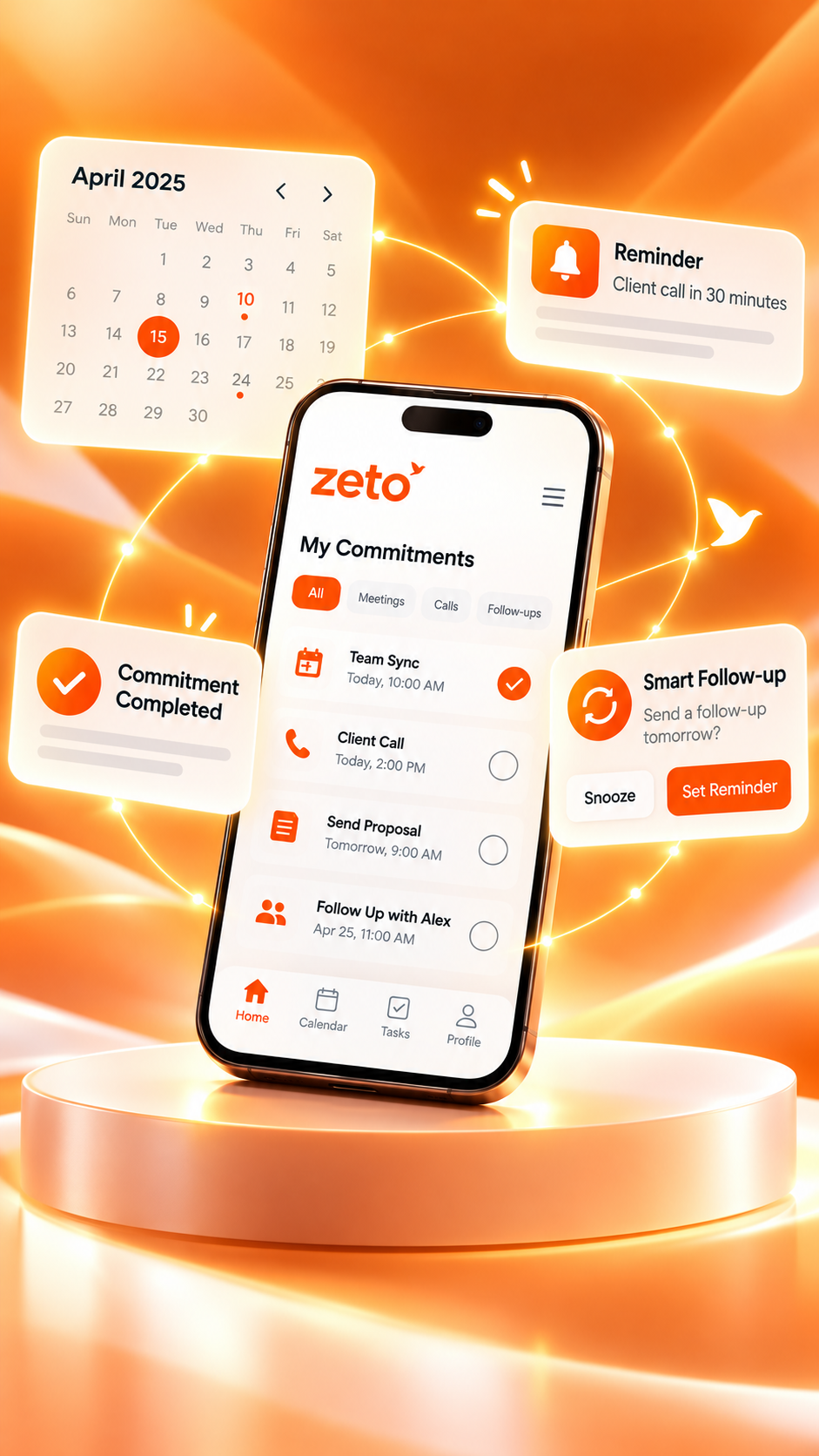
ZETO AI is designed to help people preserve useful context from their work conversations. According to its published product description, it can record supported in-person meetings and voice notes, process imported audio and notes, produce summaries, organize follow-ups and let users ask questions about earlier conversations.
Instead of simply storing a meeting recording, ZETO focuses on a practical sequence: capture, understand, follow up and ask later. That means a professional can review what was discussed, check outstanding commitments and look up a past detail before the next customer or team interaction.
For businesses, ZETO Enterprise extends that idea to permitted work conversations and operational context, helping managers review discussions, commitments and follow-through. Conversation records should support informed conversations and fair review—not replace human judgment.
Recording and import support may vary by device and platform. Phone-call recording in particular depends on recordings made by the phone's own supported calling app, where permitted; ZETO does not record those calls directly. Meeting and voice-note capture is a separate workflow.
Use AI meeting summaries responsibly.
Meetings can contain personal information, confidential commercial details and sensitive customer discussions. Before recording, make sure you understand the applicable consent and recording requirements, the people who can access the material, and the service's data-handling practices.
AI can also mishear speaker names, misinterpret a conditional statement as a commitment, or miss context during overlapping speech. When a decision has financial, contractual, staffing or customer consequences, confirm it with participants and refer to the original evidence if needed.
With clear permissions and careful review, meeting summaries can support more dependable follow-through without claiming to replace the judgment of the people in the room.
Questions professionals ask about AI meeting summaries.
What is the difference between meeting minutes and an AI meeting summary?
Traditional meeting minutes are usually prepared and approved by a person as an official record. An AI summary is created from meeting material and may save time, but it should be checked and approved before it becomes the formal record.
Can AI meeting summaries identify action items and deadlines?
Many tools can extract potential tasks, owners and dates that were discussed. Accuracy depends on how clearly the participants stated those details, so important deadlines and responsibilities should be verified.
Can I use AI summaries for in-person meetings?
Yes, if the tool supports in-person recording or uploaded audio and everyone has been informed as required. ZETO AI lists in-person meeting recording as part of its mobile app experience.
Are AI meeting summaries always accurate?
No. Audio quality, speaking styles, unclear decisions and context can affect accuracy. Review critical names, figures, commitments and deadlines before acting on them.
How do meeting summaries help with customer follow-ups?
A structured summary can record what the customer asked, the questions left open, what was promised and when the next response is expected. This helps the professional prepare for the next contact.
How does ZETO AI help retrieve previous meeting decisions?
ZETO AI organizes summaries and follow-ups and provides an Ask Zeto experience for asking questions about earlier conversations. Users should still confirm consequential answers against the referenced conversation.
Good meetings should create progress—not uncertainty.
Professionals do not need a perfect memory for every conversation. They need a dependable way to preserve decisions, understand responsibilities and return to important details at the right moment.
AI meeting summaries can make this easier by turning long discussions into more organized, searchable records. Their greatest value comes when teams review the information, confirm important commitments and use it to guide the next step.
Remember the conversation. Move forward with clarity.
Explore how ZETO AI helps organize conversations, summaries, commitments and follow-ups—so the important things are easier to find when work moves forward.